In many environments where moisture or outdoor exposure is a concern, standard printer paper just doesn’t hold up. That’s where waterproof paper comes in as a specialized paper designed to resist water damage without the need for lamination. It’s one of several printer paper types available for specific purposes, alongside photo paper, cardstock, and thermal paper. In this article, we’ll dive into its uses and benefits.
Definition: Waterproof paper
Waterproof paper is a synthetic paper that resists water, chemicals, puncturing, tearing, and extreme conditions. Unlike regular copy paper, it doesn’t absorb water, which means it remains intact and legible even after spilling drinks on it or when used underwater.
Printing and laminating at BachelorPrint
- Vivid colors & sharp details on premium materials
- Print & laminate menus, posters, certificates & more
- Durable lamination to protect your documents of any size
Learn more!
Uses
Waterproof paper is used in a wide range of professional and personal applications.
- Maps
- Menus
- Recipe cards
- Labels & stickers
- Medical bracelets
- Underwater note-taking
- Flyers
- Calendar
- Placemats
- Notebooks
- Outdoor signs
- Training manuals
Materials
Waterproof paper is engineered to resist moisture, tearing, and extreme environmental conditions, so the choice of material plays a crucial role in its performance.
Synthetic papers are entirely plastic-based, made from resin materials instead of traditional wood pulp. These materials are extruded and processed into printable sheets that resemble paper in appearance and feel, yet offer significantly superior performance. Common materials include:
- Typically used for semi-glossy or satin synthetic paper
- Extremely durable & tear-resistant
- Ideal for laser printing
- Generally stiffer than PP
- Often used in industrial, marine, and military applications
- Typically used for matte synthetic paper
- Lightweight, flexible & durable
- Smoother feel, more paper-like than PET
- Suitable for laser, flexographic, and offset printing
- Often used in retail, restaurant, industrial & creative applications
Unlike most paper types, one key characteristic of waterproof paper is that it lacks paper grain direction, which allows it to fold in any direction without compromising its structural integrity when it comes to bookbinding.
When folding the paper, it’s crucial to score it first using a folding bone or similar tool. This practice is recommended since waterproof paper is especially durable, and this will result in easier and crisper paper folding.
Printers
Many synthetic papers are designed to be written on with waterproof pens, pencils, Sharpies, and ballpoint pens. However, when it comes to professional printing, not every type of printer is compatible with this paper.
When it comes to paper size, this paper is very versatile by covering sizes like Letter, A4 paper, Ledger, A5 paper, and many more. Some waterproof papers work for inkjet printers, specifically printers using pigmented ink, as they’re not water-soluble (dissolvable) and are more resistant to fading; however, you can do no wrong with a laser printer or a copy machine, since most waterproof papers are designed to work specifically for these machines. Essentially, when it comes to inkjet vs. laser printers, we recommend laser printers when using synthetic paper.
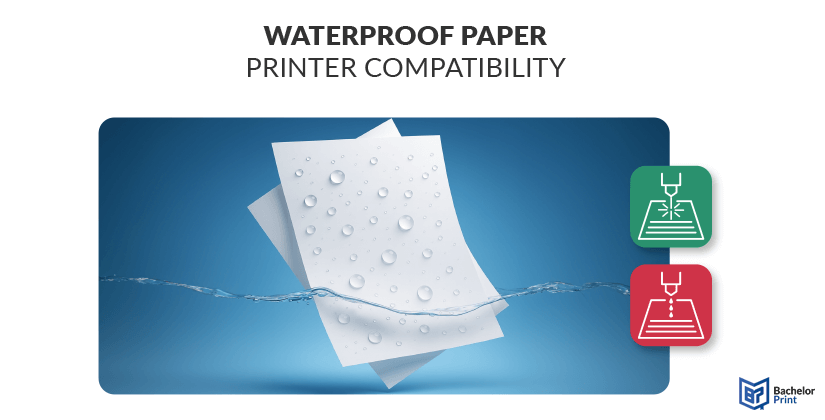
Before printing, it’s important to look up your printer’s maximum paper density and temperature in its manual. The paper’s GSM (grams per square meter) needs to be compatible with your printer’s requirements, and if you use an inkjet, make sure the paper is inkjet-compatible. In case of incompatibility, refer to a professional online printing service or a copy shop near you.
Waterproof vs. laminated paper
While both synthetic waterproof and laminated paper provide water resistance, there are key differences between the two.
| Feature | Waterproof paper | Laminated paper |
|---|---|---|
| Material | Fully plastic-based | Paper with plastic film |
| Durability | High, even under harsh conditions | Decent, but can delaminate over time |
| Print method | Printed directly onto the paper | Printed first, then laminated |
| Recyclability | Recycable as plastic | Difficult to recycle due to multiple layers |
Printing differences
Laminated paper is printed on before the lamination process, meaning it’s compatible with most types of printers, including inkjet printers. On the other hand, synthetic paper is compatible with laser printers but not with dye-based inkjets.
Thickness
Paper thickness is measured in microns (µm) for countries using the metric system, whereas North America has two common units for thickness. As mentioned in our GSM article, the measurement point (pt) is specifically used for thick paper, while mil is primarily used for plastic-based sheets.
Just like points, one mil equals 0.001 inch — and it shouldn’t be confused with a millimeter. Laminates typically range from 1 to 14 mil in thickness, with 3 and 5 mil being used for certificate printing and ID cards using lamination pouches. Waterproof printer paper usually starts around 5 mil, with 10 mil being a popular choice for menus and posters. For heavy-duty applications like military or outdoor maps, thicker sheets around 14 mil are often used.
Benefits & disadvantages
Below, we’ve listed the benefits and disadvantages that come with waterproof paper.
Pros
- High durability
- Feels more professional
- Ideal paper for outdoor trips
- Eco-friendlier than lamination
- Easier, quicker & cheaper production
Cons
- More expensive than regular paper
- Requires specific printers or settings
- May have limited availability in stores
Affordable document printing from $0.10
- Crisp text, vibrant colors & multiple paper choices
- No need to visit a shop; simply order online anytime
- Print documents, copies & reports with professional quality
Learn more!
FAQs
Waterproof paper refers to synthetic paper that is fully made from plastic. It can be printed on with laser printers or drawn on with waterproof pencils and pens.
Synthetic papers are 100% waterproof since they’re made of plastic.
Yes, however, laminated paper doesn’t last as long as waterproof paper since it can delaminate over time.
Most synthetic waterproof papers are designed for laser printers, which use heat to fuse toner onto the surface. As for inkjet printers, dye-based inks will smear or wash off, so using a laser printer is highly recommended.
