
Imagine a psychological roadmap to understand what drives human behavior — a journey through our deepest desires and motivations. That’s precisely what Abraham Maslow crafted in his iconic concept known as “Maslow’s hierarchy of needs” in 1943. This theory of motivation provides valuable insights into human motivation and has remained a widely accepted methodology, sociology research framework, and higher psychology instruction.
Definition: Maslow’s hierarchy of needs
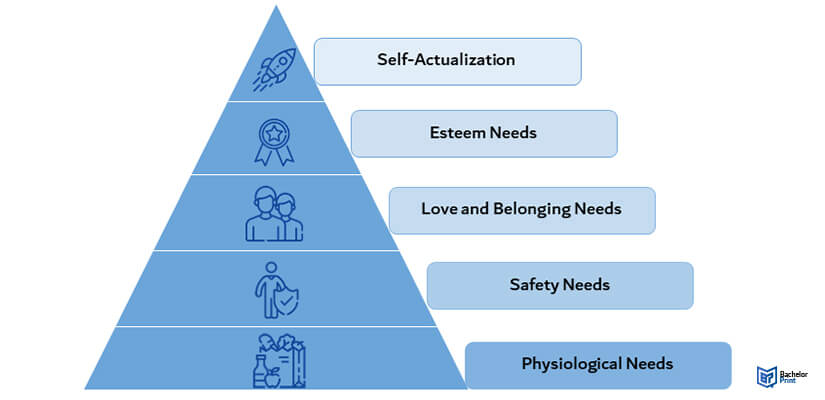
Maslow’s hierarchy of needs is a motivational theory in psychology compromising a five-stage model of human needs, often depicted as hierarchical levels within a pyramid. It was published by Maslow in 1943 in his paper, titled “A Theory of Human Motivation” and suggests that one has to fulfill basic needs first, before moving on to the more advanced needs. When a deficit has been satisfied (more or less), it will go away, and one will concentrate on the next set of needs that need to get satisfied. This framework is widely used to understand human motivation and personal development. The needs at the lower levels of the hierarchy must be satisfied before individuals can attend to needs higher up. From the bottom of the hierarchy upwards, the needs are as followed:
Overview – Maslow’s hierarchy of needs
Maslow calls the first 4 levels “deficiency needs” and the highest level the “growth/being needs”. If the deficit needs are not realized, this can have physical and psychological consequences for the individual. However, the “Self-actualization”-level can never be completely satisfied. According to Maslow, people are born with innate desires to achieve their full potential. However, in order to achieve this goal, basic needs such as food, sleep, or shelter must be met first to go on to the next levels.
At the base are physiological needs (e.g., food, water, shelter), followed by safety needs (security, health). Love and belonging needs (relationships, friendships) come next, followed by esteem needs (self-esteem, achievement). At the top is self-actualization, representing the desire for personal growth and realizing one’s full potential. Maslow’s theory suggests that individuals strive to fulfill these needs in a hierarchical sequence, with higher-level needs becoming relevant once lower-level ones are met. Here’s an in-depth look at the hierarchy theory by Maslow:
“Deficiency needs” vs. “growth needs”
Understanding the concepts of deficiency and growth needs is crucial in the context of human motivation and psychological well-being. Here’s an explanation of both terms:
Deficiency needs (d-needs)
“Deficiency needs” are fundamental psychological and physiological needs that must be satisfied to maintain a baseline level of well-being. They are called “deficiency” because their absence or deprivation can lead to discomfort, distress, or deficiency in one’s life. However, the motivation of fulfilling these basic survival needs will become stronger, the longer the needs are unmet or denied.
They are typically categorized into the lower levels of Maslow’s hierarchy of needs:
- Physiological needs
- Safety needs
- Love & belongingness needs
- Esteem needs
Growth needs (b-needs)
“Growth needs” (also known as “being needs”), in contrast, represent higher-level psychological needs that are not driven by deficiency but rather by a desire for personal development, self-fulfillment, and self-actualization. They reflect the pursuit of becoming the best version of oneself. However, once engaged, the needs can get even stronger and continue to be felt. According to Maslow, the highest-level needs of self-actualization can never be reached. However, there are moments in life, such as childbirth or weddings, where growth needs might be felt. Growth needs are motivating in themselves, as they motivate to experience personal growth and are categorized as the higher-level growth needs in the pyramid.
- Self-actualization need

According to Maslow’s hierarchy of needs, physiological needs represent the basic level physical requirements for human survival and include homeostasis, food, and water; these are the most proponent of all conditions. If the physiological needs are not satisfied, and an organism has other requirements, the individual will push them into the background until the physiological needs are met. Physiological needs can be defined as traits and a state. The traits refer to the long-term needs required for basic human life, while the state refers to the unpleasant reduction in pleasure and increase in the urgency to meet a necessity.

Safety needs represent the second level in the hierarchy, just above the physiological needs. Once physiological needs are met, one’s naturally seeking for safety and security. These needs encompass the desire for physical and psychological safety, security, and protection from harm or danger. These needs can be further broken down into two main categories:
Physical Safety: This includes the need for a safe and secure environment free from physical threats such as violence, accidents, or natural disasters. It encompasses the desire for personal safety and the safety of loved ones.
Psychological Safety: This relates to the need for emotional and psychological security. It involves feeling safe in one’s relationships, being free from excessive anxiety, and having a sense of predictability and control in life.

In Maslow’s hierarchy of needs, belongingness and love needs will emerge after the physiological and safety requirements are reasonably well satisfied. The “love-needs” involve receiving and giving affection, both romantic and platonic. An individual lacking this will feel the absence of relations and will hunger for it. The belonging need consists in wanting to feel part of a clan, a sense of belongingness. Having achieved other lower-level conditions, satisfying love and belonging needs will be an individual’s top priority. It is possible that the individual may forget that this requirement appeared unnecessary when they lacked the necessary physiological conditions.

Maslow postulates that esteem needs may be divided into two categories. First, self-esteem, such as the desire for strength, competence, and confidence in front of others, and it produces adequacy and usefulness when satisfied. Secondly, esteem from others involves the need to be recognized, respected, and appreciated by others. Individuals will participate in activities to gain recognition. Maslow further states that the healthiest self-esteem needs to be based on respect from others that is deserved rather than unwarranted respect, such as one that comes with extreme fame. A lack of self-esteem and missing respect from others can produce feelings of inferiority.
According to Maslow, this need is most important for children and adolescents to create a sense of real self-esteem and dignity.

Self-Actualization is the highest level of need in Abraham Maslow’s Hierarchy of Needs theory. It represents the pinnacle of human psychological development and fulfillment. It refers to the innate human drive to reach one’s full potential and become the best version of oneself and involves the realization of personal talents, creativity, and a deep sense of purpose and meaning in life. This level is characterized by a strong desire for personal growth, authenticity, and the pursuit of individual potential. However, the humanist himself did not believe that everyone could achieve true self-actualization, but that all of us experience transitory moments, also known as “peak experiences”. For instance, personally significant moments such as childbirth or examination success are difficult to achieve and maintain consistently.
The expanded hierarchy of needs
Maslow’s hierarchy of needs was initially a five-tier model, with the levels arranged from basic to complex needs. However, Maslow later expanded his original hierarchy during the 1960s to include additional levels, making it an eight-stage model. The expanded version includes eight tiers, incorporating three levels above self-actualization. Here’s a breakdown:
- Physiological Needs (air, food, drink, shelter)
- Safety Needs (security, order, law, stability)
- Love & Belongingness Needs (friendship, intimacy, being part of a group)
- Esteem Needs (esteem for oneself and from others)
- Cognitive Needs (knowledge, understanding, curiosity, exploration)
- Aesthetic Needs (appreciation and search for beauty, balance, form)
- Self-Actualization Needs (realizing personal potential, self-fulfillment)
- Self-Transcendence Needs (mystical experiences, pursuit of science, religious faith)
This expanded hierarchy adds more complexity to Maslow’s initial model and emphasizes not only the fulfillment of personal potential but also the realization of transcendent goals and the satisfaction of aesthetic and cognitive needs. It also provides a more comprehensive framework for understanding human motivation and the various dimensions of personal and collecive well-being.
Characteristics of self-actualizers:
Self-actualizers are individuals, who have reached a high level of psychological development and are fulfilling their unique potential. Characteristics of self-actualizing people, as identified by Maslow, include:
- Highly creative
- Need for privacy
- Peak experiences
- Unusual sense of humor
- Spontaneous in thought and action
- Problem-centered
Famous self-actualized individuals include Abraham Lincoln, Albert Einstein, and Mother Teresa.
Behavior leading to self-actualization
Self-actualization is a lifelong journey, and there are various behaviors and strategies that can help individuals progress toward this state of personal fulfillment and realization of their potential. Here are some behaviors and practices that can contribute to self-actualization:
- Experiencing life like a child, with full absorption and concentration
- Trying new things instead of sticking to safe paths
- Avoiding pretense (“game playing”) and being honest
- Taking responsibility and working hard
Critical Evaluation
Abraham Maslow’s theory of needs has been influential in psychology and related fields and had a major contribution to teaching and classroom management. Nevertheless, it has also faced several criticisms and challenges over the years. Here are some of the key criticisms:
- Lack of Empirical Evidence: One of the primary criticisms of Maslow’s theory is the lack of empirical evidence to support its hierarchy and the idea that needs are structured in a strict, hierarchical manner. Critics argue that Maslow’s theory is more conceptual and theoretical than based on rigorous scientific research.
- Inflexibility: Critics argue that Maslow’s hierarchy implies a linear and rigid progression through the needs, with one need needing to be fully satisfied before moving on to the next. In reality, individuals may address multiple needs simultaneously or revisit lower-level needs even after achieving self-actualization.
- Ignoring negative behavior: Some critics argue that Maslow’s theory tends to ignore or downplay negative aspects of human behavior, and destructive actions. It does not provide a comprehensive explanation for why individuals engage in behaviors that do not align with self-actualization.
FAQs
Abraham Maslow’s Hierarchy of Needs theory includes five hierarchical levels of human needs, which are often represented in the shape of a pyramid. These needs, starting from the most fundamental and moving toward higher-level psychological needs, are as follows:
- Physiological Needs
- Safety Needs
- Love & Belongingness Needs
- Esteem Needs
- Self-Actualization
The pyramid of needs is important for several reasons, and its significance extends across multiple fields, including psychology, education, business, and personal development.
- Physiological Needs: Food pantries, emergency shelters
- Safety Needs: Security systems, health insurance
- Love & Belongingness needs: Friendship and Social Events, Family Support
- Esteem Needs: Academic Achievements, Employee Recognition
- Self-Actualization: Artistic Pursuits, Entrepreneurship
The pinnacle of Maslow’s hierarchy of needs is Self-Actualization.
The expanded version of the hierarchy of needs by Abraham Maslow incorporates additional layers to address cognitive and aesthetic needs, as well as the concept of self-transcendence, which reflects the human drive to connect with something larger than oneself. It acknowledges that individuals may pursue personal growth and fulfillment in various ways, including through intellectual pursuits, creativity, and altruism.
