Poster printers are designed to produce sharp graphics and accurate colors as they are widely used in marketing, education, retail signage, and events. This type of printer can handle large formats and typically comes in the form of inkjet printers and large-format plotters. In this article, we’ll delve into the subject of poster printers, ideal printer paper, and if it’s worth investing in such a device.
Definition: Poster printer
A poster printer is a printer that is specifically built to produce large, high-resolution prints used for visual display. Unlike standard office printers, poster printers typically support:
- Large paper sizes (e.g., A3, A2, A1, A0, 11×17, 24×36)
- Specialty media like glossy, matte, or coated stock
- Wide color gamut for design accuracy
11×17 printing at BachelorPrint
- Large format print for posters, plans & presentations
- Fast turnaround & reliable delivery right to your door
- Brilliant color quality & details on premium paper from $0.15
Learn more!
Poster paper
Poster paper is print media that’s engineered for high ink density and dimensional stability in large-format output. There are several common types of poster paper:
| Type | Paper weight | Best for |
| Glossy | 180–260 gsm / 48–70 lb text | Photo posters, event promos, advertisements |
| Matte | 170–230 gsm / 45–61 lb text | Art prints, readable signage |
| Satin/Luster | 200–260 gsm / 54–70 lb text | Professional display graphics |
| Blue-back | 115–150 gsm / 30–40 lb text | Billboards, fly posters |
| Synthetic | 120–200 gsm / 32–54 lb text | Outdoor use, high-traffic areas |
Printing posters
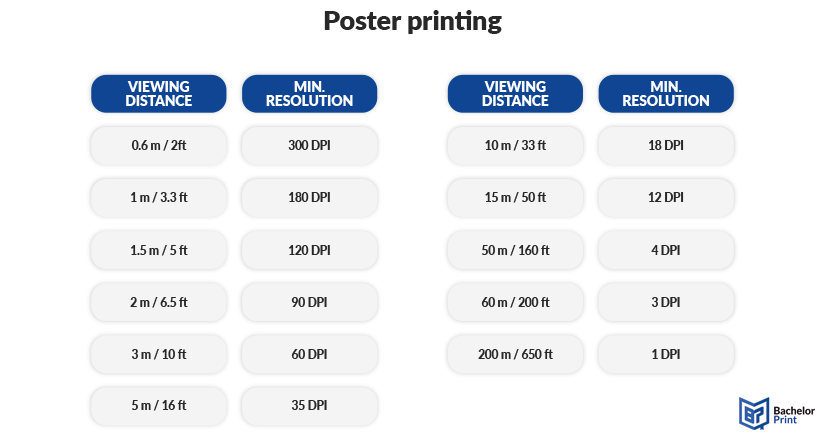
When it comes to poster printing, you need to make sure that image resolution matches how the poster will be viewed. The closer someone stands to a print, the higher the detail required.
For 24×36 prints, 150 DPI should provide sharp results at normal wall-viewing distance while also being less demanding on your computer. For regular prints that you hold in your hand and look at closely, 300 DPI is common. If the poster is even bigger and farther away, 100 DPI or less is also acceptable.
Is buying a poster printer worth it?
Buying a poster printer can be worth it for bigger businesses or educational organizations, e.g., the HP DesignJet Z9 44″ or the Canon imagePROGRAF Pro-4600 44″. However, if you want to print posters at home, we recommend getting a regular inkjet printer for Letter- or A4-sized posters, or, if you really need to print large posters at home, invest in an A3 printer. For cheaper large-format posters, we recommend ordering from an online printing service or asking local stores to print them for you.
Why a poster printer might not be worth it
Purchasing a poster printer might not be worth it due to:
- Printer cost: Poster printers are only worth it if you print posters continuously. They not only take up a lot of space but are also very pricey — we’re talking $700 upwards.
- Supplies: It’s safe to say that supplies for poster printers are also quite expensive. You require large high-quality paper, lots of printing ink, and lots of patience.
- Maintenance: Poster printers need to be run all the time, if not, the liquid ink can clog the nozzles, which can be a hassle to fix. This is a common issue with inkjet printers of any size.
FAQs
Both A3 and A4 can be posters; however, A4 would be a small poster or flyer size, and A3 would be a standard small poster size, whereas A2, A1, or A0 sizes are mostly common for large posters viewed at a distance.
That depends on use:
- For art prints: Matte fine art paper
- For indoor display: Glossy or satin photo paper
- For professional posters: Heavyweight coated paper
- For outdoor display: Water-resistant or waterproof paper
Costs vary by location and quality. For basic A5/A6 flyers (single-sided, color), costs may range from $15 to $40, although you can get them at BachelorPrint for less. For double-sided or higher-quality paper, it may cost around $40 to $80.
You need a large-format inkjet printer. These printers handle bigger paper sizes, produce better color gradients, and support thicker poster media compared to standard office printers.
