When it comes to printer paper types, bond paper is possibly one of the most commonly used in offices, schools, and homes. It’s typically chosen for documents that require a more professional look or stronger texture than standard copy paper, specifically legal and business documents. In this article, we’ll thoroughly dive into the topic of bond paper, its uses, paper weight, types, and benefits.
Definition: Bond paper
Bond paper is a high-quality, durable writing paper that was originally used for printing government bonds in the late 1800s, which is how it got its name. Nowadays, it’s widely used for printing letterheads, business documents, and stationery. Unlike regular paper, bond paper is primarily made from cotton rags (20-100%), with wood pulp used as a filler. This composition allows bond paper to be extra sturdy.
Affordable document printing from $0.10
- Crisp text, vibrant colors & multiple paper choices
- No need to visit a shop; simply order online anytime
- Print documents, copies & reports with professional quality
Learn more!
Uses
Bond paper can be used with not only inkjet printers but also laser printers for:
- Documents
- Letterheads
- Cover letters
- Printer paper
- Business forms
- Handwritten notes
- Reports
- Resumes
- Sketches
- Drawings
- Proposals
- Blueprints
If you’d like to comfortably order custom reports, resumes, business forms, letterheads, and other documents from home, consider a professional online printing service.
Types
Bond paper isn’t just one kind of paper, it comes in several varieties depending on its intended use. These types include the following:
Uncoated
Plain, uncoated bond paper is the most commonly used paper type for everyday business document printing. It’s smooth, non-reflective, and often includes laid and linen textures for a subtle tactile feel. This type is ideal for printing ink or toner absorption.
Coated
Coated bond paper has a layer of paper coating that either has a glossy or matte finish. The glossy variant makes colors pop, so it’s an excellent choice for images and brochures. Matte-coated bond paper has a textured feel and is suitable for text-heavy documents.
Translucent
Translucent bond paper (or translucent bond) is an economical and cheaper alternative to vellum paper when it comes to blueline copies and overlays. As the name suggests, it’s less opaque than traditional bond paper and is often sold on a long roll.
Weight
Due to its composition, bond paper tends to be heavier and more durable than standard copy paper. It’s typically available in weights from 75 gsm (US: 20# bond or 50# text) to 90 gsm (US: 24# bond or 60# text), but heavier weights are also available for more formal or premium uses.
Bond paper vs. copy paper
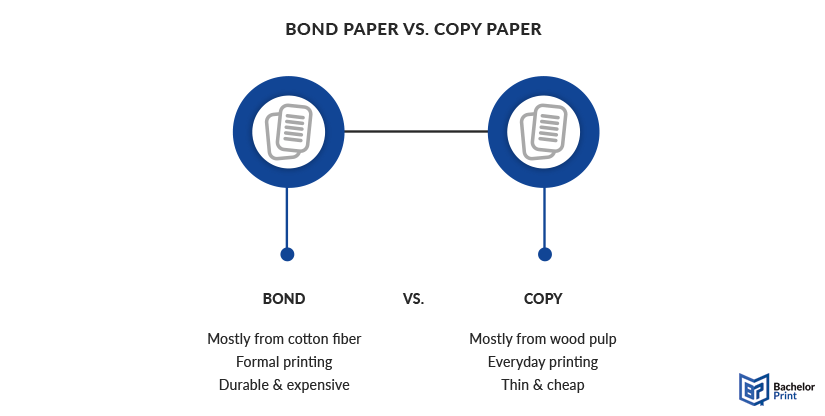
The image below depicts the differences between bond paper and copy paper.
Benefits & disadvantages
Below, we’ve listed the benefits and disadvantages of bond paper.
Pros
- Strong & durable
- Professional appearance
- Compatible with most printers
- Available in many weights & finishes
- Suitable for long-term document storage
Cons
- More expensive than copy paper
- Not cost-effective for bulk printing
- May cause paper jams in low-end printers
Professional CV printing at BachelorPrint
- Custom CV printing with premium paper & finishes
- Choose between A4 size & Letter size for just $0.10
- Benefit from fast production & express delivery
Learn more!
FAQs
Bond paper is a durable paper made from a mix of cotton fibers and wood pulp. It’s commonly used for official documents and forms due to its strength and high opacity.
Bond paper is used when you need more polished, long-lasting documents, such as resumes, contracts, letterheads, or legal forms. Its texture and weight make it ideal for professional printing.
Yes, bond paper is compatible with most inkjet and laser printers. However, for heavier weights, make sure your printer can handle thicker paper to avoid jams.
Bond paper is generally thicker and more durable compared to copy paper. Copy paper is lighter, more affordable, and designed for everyday printing tasks like documents and drafts.
