A simple print job, no matter how extraordinary the quality, will always be ink on paper. To make a print truly stand out and catch the eyes of people, you can use different methods of print finishing to elevate your work. Especially in bookbinding, it is a highly requested technique to have a book noticed in stores or online. Currently, there is a trend to paint the fore-edge of a book, adding another intriguing layer to it. This article will dive into the history and process of fore-edge painting.
Inhaltsverzeichnis
Definition: Edge painting
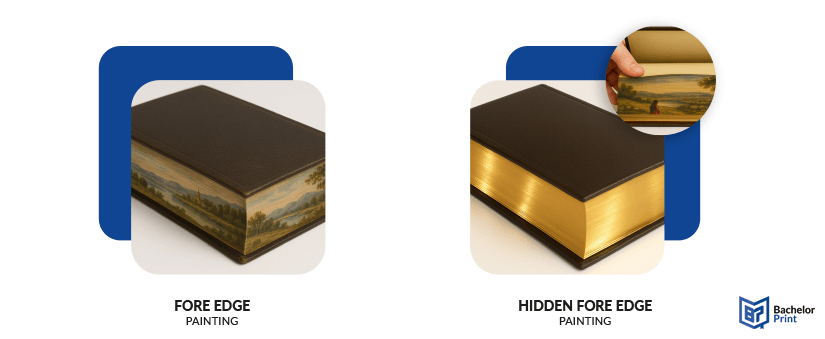
Edge painting describes the craft of painting the opening side of a book, called the fore-edge, either in a visible image or a hidden one. The visible image is simply painted on the unbound side of the book, while hidden fore-edge paintings are usually only visible when the book is fanned. They are typically hidden under gilded edges and preserve the original historic craft.
Hardcover with individual embossing
- Price calculator & 3D live preview
- Professional binding for thesis, dissertation, or books
- Print on demand with fast delivery right to your doorstep
Learn more!
History
Modern edge paintings are very straightforward, as the image is simply painted on the front edge of the book. However, fore-edge paintings have been around for over two centuries, gaining popularity in the 19th century, although they originated back in the 16th century. The original fore-edge paintings were invented to mark ownership on the loose end of the book, while richer people had artists decorate them to their liking. The hidden ones were invented by the Edwards family of Halifax in England, who were eccentric booksellers. There, they were used to hide an image under gilded pages, which only reveals when opening the book and fanning the pages a little.
The original craftsmanship is slowly dying, since traditional fore-edge painters do not earn enough money for their work, and many young people, especially on social media, paint their book edges nowadays. Although these are often straightforward artworks on the edge, some people still practice the traditional way of hidden art under gilded pages.
Process
The process of making edge paintings, regardless of which kind, is not hard at all. First, you clamp the book into a book press, straight if you want a normal edge painting, or fanned until the gilded part is not visible anymore if you want a hidden one.
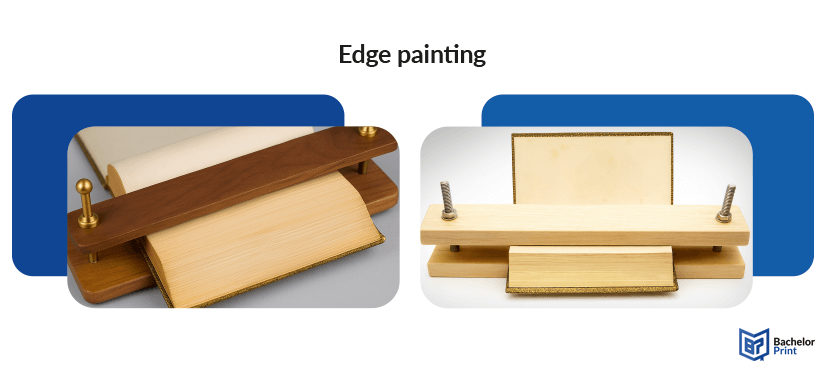
On the fixed book, you can then paint the image, usually done with watercolors, and then let it dry. After the paint has dried, the book can be retrieved from the press and carefully leafed through to separate all the pages.
Note: You can paint all three open ends of the book if you’d like. In a hidden edge painting, you can even fan it both ways to create two edge paintings, although only on the long front.
Variations
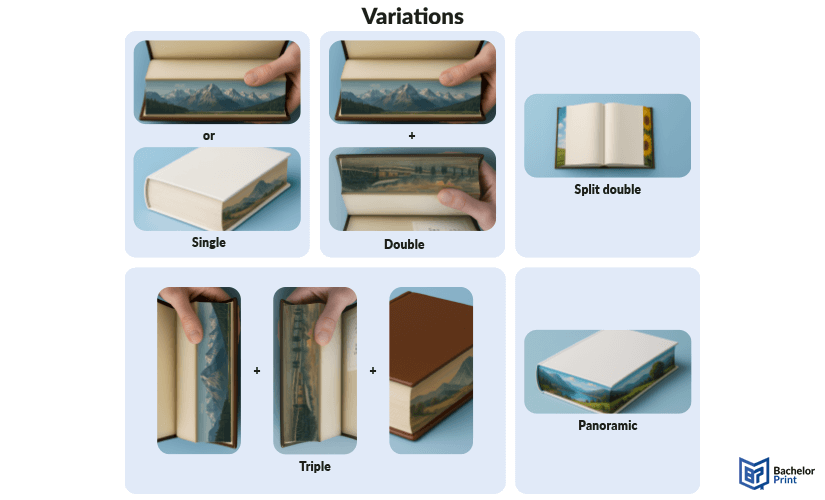
There are several variations in edge painting, depending on how many and where the artworks are applied.
- Single: Only one side of the book is painted; either it is a hidden painting or a straightforward one.
- Double: Two paintings are done on one side of the book, visible when fanning it into different directions.
- Triple: This type has a straightforward painting in addition to two in different fanned directions.
- Panoramic: The image is spread around all three opening sides of the book.
- Split double: There are two paintings that show properly when the book is opened in the middle, and each side is fanned in another direction.
Paperback with your individual design
- Individual design for thesis, dissertation, or books
- Order online with fast delivery right to your doorstep
- Use a customizable pre-made design or create your own
Learn more!
FAQs
Edge painting is the art of painting the fore-edge of a book, either with a hidden artwork, which is only revealed when the book is fanned open, or a direct one that you can see when the book is closed.
The edges of a book can be painted by putting the book into a book press, securing the text block tightly, and then painting on the surface with, for example, watercolors. Afterwards, it needs to sit until it is completely dry before removing it from the press.
For edge painting, the best-suited type of color is usually watercolor or other water-based colors such as gouache.
