Colors must be communicated precisely, especially when a design becomes a physical print color on paper, metal, plastic, or coated surfaces. Screens can mislead, but standardized systems prevent errors. One of the most important European standards for this is RAL. This system enables designers, printers, manufacturers, and suppliers to refer to exactly the same shade.
RAL explained briefly
RAL is a European standardized color matching system that defines precise, pre-set colors using unique codes. It ensures consistent color reproduction across industries such as printing, coating, architecture, and manufacturing. Instead of saying “dark red,” you specify RAL 3003, and the color is clearly defined.
Definition: RAL
RAL is one of the most established standardized color systems worldwide. It’s managed by RAL gGmbH, a German non-profit organization responsible for maintaining official RAL standards.
The purpose of RAL is to:
- Provide binding color references
- Enable reliable color communication in industry
- Ensure consistency across materials and suppliers
History
RAL has industrial roots:
- Founded in 1925 as Reichs-Ausschuß für Lieferbedingungen (Imperial Committee for Delivery)
- Originally created to standardize technical supply specifications
- The first RAL CLASSIC collection appeared in 1927 with 40 shades
- Today, the RAL systems together contain around 2,500+ predefined colors
What began as an industrial efficiency tool is now one of the most important color standards in Europe.
PDF printing at BachelorPrint from $0.10
- Upload your files & order printed PDFs in minutes
- Secure online PDF printing service with reliable delivery
- High-quality prints from any PDF, including reports & more
Learn more!
How it works
RAL colors are based on physical reference samples, not digital values. Each color has a code:
- Format: RAL XXXX
First digit meaning
The other digits are sequential identifiers.
Structure of code ranges
Range
Range name
First
Last
Quantity
RAL
1XXXYellow
RAL 1000 Green beige
RAL 1037 Sun yellow
30
RA
2XXXOrange
RAL 2000 Yellow orange
RAL 2017 RAL Orange
14
RA
3XXXRed
RAL 3000 Flame red
RAL 3033 Pearl pink
25
RA
4XXXViolet
RAL 2000 Yellow orange
RAL 2017 RAL Orange
14
RA
5XXXBlue
RAL 5000 Violet blue
RAL 5026 Pearl night blue
25
RA
6XXXGreen
RAL 6000 Patina green
RAP 6039 Fibrous green
37
RA
7XXXGray
RAL 7000 Squirrel gray
RAL 7048 Pearl mouse gray
38
RA
8XXXBrown
RAL 8000 Green brown
RAL 8029 Pearl copper
20
RA
9XXXBlack/White
RAL 9001 Cream
RAL 9023 Pearl dark grey
15
Why do the gray numbers go to 7048, but only 38 shades exist?
Not every number in the sequence is assigned. Some codes were discontinued, reserved, or never used. Thus, the numbering isn’t continuous.
Three major RAL collections
Collection
Purpose
Colors
RAL CLASSIC
Industrial standards
216
RAL DESIGN System plus
Creative design
1,825
RAL EFFECT
Product & industrial design incl. metallics
490
Unlike CLASSIC, RAL DESIGN uses seven-digit codes that are based on the CIELAB color model. It uses color hue, lightness, and chroma, making it more systematic for designers.
Official vs. reference RAL tools
Not every RAL color guide has the same authority:
- Fan decks and printed charts are reference tools and can show minor deviations caused by printing and material differences.
- RAL 840-HR (semi-matte) and RAL 841-GL (gloss) are the official color registers used for quality control and industrial matching
- These registers include precise colorimetric data and serve as binding standards when production accuracy is technically or legally critical.
This matters in manufacturing, industrial coating, and regulated industries that require binding standards, not just visual guides. RAL defines the color standard, while manufacturers reproduce it in their materials.
Why RAL colors look different on materials & under light
RAL colors are defined, but their appearance changes depending on:
- Finish (matte, satin, gloss)
- Lighting (daylight vs. artificial)
- Material (metal, plastic, paper)
- Surface texture (smooth vs. textured)
The RAL EFFECT collection includes metallic and special-effect pigments that cannot be accurately represented on screens or in standard printing. That is why physical samples are always required for final approval.
RAL in digital workflows
While RAL is a physical standard, digital planning tools exist. RAL Digital software allows designers to:
- Access color coordinates
- Browse RAL palettes digitally
- Plan color schemes before production
- Use RAL colors in CAD and design software
However, digital previews are only approximations. Final decisions must be based on physical RAL samples.
Products & uses
The most important RAL color tools include:
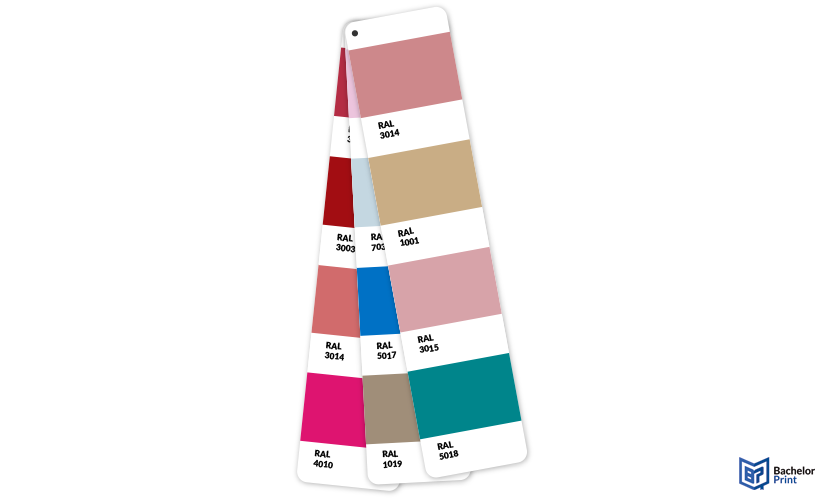
- RAL K7 fan deck: 216 CLASSIC colors, gloss finish
➜ Each page shows multiple swatches with the color code and name.
- RAL K5 chart: Single color per page, gloss or semi-matte
➜ Because the swatch is larger, it allows more precise visual assessment.
- RAL D3 plus booklet: All RAL DESIGN colors
➜ Used in applications where systematic color planning is required.
These tools are essential because screens cannot reliably display RAL colors.
How to choose
Choosing a RAL color is not just about picking what looks good on a screen. Because RAL is a physical color standard, selection must consider environment, materials, and surface properties to ensure the final result matches expectations.
Step-by-step
- Define the application
Start by clarifying where and how the color will be used:
- Indoor or outdoor?
- Exposed to weather, UV light, or chemicals?
- Material: metal, plastic, wood, paper, or coated surfaces?
Different materials reflect light differently, which affects perceived color.
- Use a physical RAL fan deck
Always evaluate colors using an official RAL reference tool. Digital screens and printouts are only approximations and may lead to incorrect decisions.
- Check lighting conditions
Colors appear different depending on the light source:
- Daylight ➜ Cooler, more neutral
- Warm indoor lighting ➜ More yellow/red
- Industrial lighting ➜ Can flatten contrast
Evaluate the color under the same lighting conditions where it will be used.
- Confirm the finish
Gloss, satin, and matte finishes influence color perception:
- Gloss ➜ Appears darker and more saturated
- Satin ➜ Appears balanced and true to tone
- Matte ➜ Appears softer and lighter
Finish can be just as important as the color code itself.
- Consult suppliers for critical applications
In industrial production, architecture, or regulated sectors, confirm color reproduction with manufacturers. They ensure compliance with standards and material-specific tolerances.
High-quality color copies from just $0.18
- Choose from different paper formats & paper weights
- Configure finishing options & add any extras you need
- Easy online ordering process with delivery to your doorstep
Learn more!
RAL vs. other color systems
RAL does not replace print color models like CMYK or Pantone colors. Instead, it belongs to a different category of color definition.
RAL vs. Pantone
Pantone defines printing inks, while RAL defines surface colors used in industry. A Pantone color can be printed directly. An RAL color usually needs to be approximated in CMYK or reproduced as a custom spot ink.
RAL vs. CMYK
CMYK mixes four inks to simulate colors in printing. It is a process model, not a fixed color library. Because of this, not all RAL shades can be reproduced accurately in CMYK, especially very bright, deep, or metallic tones.
RAL vs. RGB
RGB colors exist as emitted light on screens, while RAL colors are based on reflected surface light. This fundamental difference explains why colors that look vibrant on a monitor appear different once printed.
Overview
System
Purpose
Nature
RAL
Industrial & material colors
Physical standard
Pantone
Graphic design & print spot colors
Ink system
CMYK
Printing process colors
Process model
RGB
Screens
Light model
FAQs
Historically yes, but today it functions more as a brand name for the color standard.
Originally, RAL stood for Reichs-Ausschuß für Lieferbedingungen. Today, it mainly represents the RAL color standard managed by RAL gGmbH.
Yes, especially in industrial coatings, architecture, and international manufacturing. However, systems like Pantone are more common in US printing.
Across all systems, there are over 2,500 colors, including 216 in RAL Classic alone.
