Have you ever wondered why certain designs or artworks feel deep, elegant, or three-dimensional rather than flat? Color shades play a major role in how we perceive depth, contrast, and mood, especially in printed products. In this guide, you’ll learn what a color shade is, how it differs from related color concepts, and why shades matter so much in professional print design.
Color shade explained briefly
A shade is a version of a color made darker by adding black. In printing, shades create depth, contrast, and visual hierarchy.
Inhaltsverzeichnis
Definition: Color shade
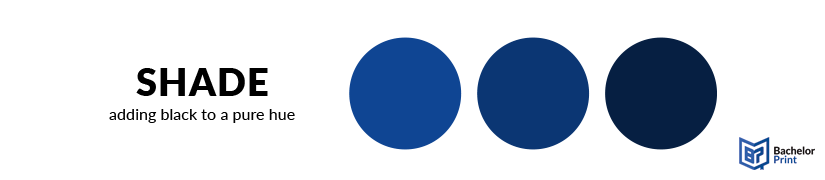
A color shade is created by adding black (darkness) to a pure color hue or to a mixed color. This process darkens the color without changing its basic hue. Shade is related to color tint, but instead of adding white (lightness), black (darkness) is added.
- A shade always results in a darker version of a color.
- The more black added, the darker the shade appears.
➜ In print color, shades are often used to create depth and contrast.
High-quality color copies from just $0.18
- Choose from different paper formats & paper weights
- Configure finishing options & add any extras you need
- Easy online ordering process with delivery to your doorstep
Learn more!
Popular examples
Certain shades are widely used in print, branding, fashion, and interior design because they communicate stability, elegance, or seriousness:
These shades are frequently used in brochures, book covers, business reports, and academic print products.
How to find
When working on a print project, you often need exact color codes rather than visual approximations.
- Adobe Color: Generates shades and exports RGB, HEX, or CMYK values
- Pantone Connect: Industry-standard shades for consistent print results
- HTML Color Codes: Quick Lookup for hex codes and RGB values
- W3School’s Color Picker: A simple tool for experimenting with darker variations
Impact & effect
Color shades influence how designs are perceived emotionally, functionally, and commercially.
Shades tend to feel heavier, calmer, and more sophisticated than bright hues or light tints.
In branding, choosing the right shade can strongly influence perception and memorability.
➜ Consistent use of a specific shade improves brand recognition by up to 80 %.
Shades play a key role in structuring (printed) layouts.
In printed photos, darker shades enhance realism and contrast.
PDF printing at BachelorPrint from $0.10
- Upload your files & order printed PDFs in minutes
- Secure online PDF printing service with reliable delivery
- High-quality prints from any PDF, including reports & more
Learn more!
Considerations
The use of color shades in print requires attention to contrast, color systems, and visual clarity.
Readability & accessibility
- High contrast between text and background is essential
- Dark text on light backgrounds (or vice versa) improves readability
- Proper shade contrast supports users with visual impairments
RGB vs. CMYK
Shades behave differently depending on the color system.
- RGB (additive) = digital screens
- CMYK (subtractive) = printed materials
➜ A shade that looks deep on screen may appear flatter or darker in print.
Visual hierarchy
Designers use darker shades to guide attention.
- Darker elements feel heavier and more important
- Shades help highlight headlines, buttons, or key information
- Proper shading improves scanning and comprehension in print layouts
Cultural variations
Color interpretation varies by culture.
FAQs
A color shade is a darker variation of a color created by adding black to a hue.
Silver is generally considered a metallic color, not a shade, because its appearance depends on light reflection rather than darkening a hue with black.
No. A shade does not describe a separate color but a variation of an existing color that has been darkened.
Any color can have shades. Every hue can be darkened by adding black, resulting in one or more shades of that color.
