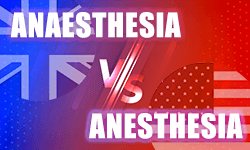
Maintaining clarity and logic in academic writing necessitates consistent language usage. However, students often struggle to differentiate between British English vs. American English, especially with spelling differences such as “anaesthesia” and “anesthesia.” This can be particularly challenging for those who are not native English speakers. For a clearer understanding of these language variations, keep reading.
“Anaesthesia” or “anesthesia”
“Anaesthesia/anesthesia” refers to a state of temporary induced loss of sensation or awareness. It can be used for medical procedures to prevent patients from feeling pain during surgery. There are no synonyms for the medical term. The word functions grammatically as a noun. “Anaesthesia” with an “ae” is the spelling used in British English. “Anesthesia” with an “e” instead of “ae” is the spelling commonly used in American English.
There aren’t typically alternate notations used for “anaesthesia/anesthesia” beyond these spelling variations. Both terms are widely understood and used in their respective varieties of English, with no recommendation for change or preference for one over the other outside of regional usage norms.

British English
anaesthesia

American English
anesthesia
Each spelling is predominantly used in its respective form of English, and there are no commonly accepted alternative spellings within each English variety. Thus, “anaesthesia” is standard in British contexts, while “anesthesia” is standard in American contexts, with each region typically using only its respective spelling.
Examples of using “anaesthesia” and “anesthesia” as a noun
The following examples will illustrate the difference in the spelling of the noun “anaesthesia/anesthesia” in British and American English.
- British English: Anaesthesia
- American English: Anesthesia


“Anaesthesia” or “anesthesia” as a verb
The verb forms of the nouns “anaesthesia” and “anesthesia” are “anaesthetize” in British English and “anesthetize” in American English. These verbs mean to administer anesthesia to render a person or animal insensible to pain.
British English
- Infinitive: to anaesthetize
- Past tense and past participle: anaesthetized
- Present participle: anaesthetizing
American English
- Infinitive: to anesthetize
- Past tense and past participle: anesthetized
- Present participle: anesthetizing
These forms maintain the consistent spelling differences between American and British English, with “ae” typically used in British and “e” in American English, as can be seen in the noun form; however, both variants use “z” in the verb form.


“Anaesthesia” or “anesthesia” as an adjective
The adjective forms “anaesthetized” in British English and “anesthetized” in American English both derive from their respective verbs “anaesthetize” and “anesthetize.” They are used to describe something that has been subjected to anesthesia.
- British English: anaesthetized
- American English: anesthetized


FAQs
Both “anaesthesia” and “anesthesia” are correct, depending on the form of English being used. “Anaesthesia” is British English, and “anesthesia” is American English.
“Anaesthetic” is a noun in British English referring to the drug or agent that produces a partial or complete loss of feeling. The American English equivalent is “anesthetic.”
In Australia, both the British and the American English variant of the word is used. However, Australians slightly prefer “anesthesia” over “anaesthesia.”
Printing Your Thesis With BachelorPrint
- High-quality bindings with customizable embossing
- 3D live preview to check your work before ordering
- Free express delivery
Configure your binding now!
