Woodcut is one of the oldest and most influential printmaking techniques, dating back over a thousand years. Originally developed as a practical method for reproducing images and text, woodcut soon evolved into a respected artistic medium. Today, it remains a powerful form of visual expression in contemporary art, design and political illustration.
Woodcut explained briefly
Woodcut is a traditional relief printmaking technique where an image is carved into a wooden block, leaving raised areas that are inked and pressed onto paper to create bold, high-contrast prints. Originating over a thousand years ago, it played a key role in early image and text reproduction and remains influential in art and design today.
Definition: Woodcut
A woodcut is a relief printing technique in which an image is carved into a wooden block. The artist removes the non-printing areas, leaving the design raised above the surface. When ink is applied to these raised parts and paper is pressed against them, the ink transfers to produce the print.
As part of the broader category of printmaking, woodcut is closely related to wood engraving, linocut, and letterpress printing, all of which rely on the same relief principle: what remains raised on the block prints; what is cut away stays blank.
Traditionally, artists use fine-grained hardwoods such as pear, cherry, or lime wood because of their smooth surfaces and durability during printing.
Printing services at BachelorPrint
- Individual solutions & personal support
- High print quality & fast production times
- Wide range of print products for every need
Learn more!
History
The history of woodcut spans more than a millennium and reflects the evolution of both communication and artistic expression. It has continually adapted to new purposes and cultural contexts.
Origins in Asia
The woodcut technique originated in China during the 5th century, where it was used to print Buddhist scriptures, decorative patterns, and images on paper and textiles. The method quickly proved ideal for reproducing sacred and literary works.
It later spread to Japan and Korea, where it evolved into distinctive artistic traditions, most notably Japan’s ukiyo-e prints, which depicted landscapes, kabuki actors, and scenes from everyday life and would later influence Western artists.
Introduction to Europe
By the 14th century, woodcut reached Europe. It was initially used to create religious images and playing cards. However, its role expanded significantly after Johannes Gutenberg’s invention of movable type in the mid-15th century, as woodblocks could be printed alongside text, making them essential for early book illustration.
During the Renaissance, artists such as Albrecht Dürer transformed the technique from a practical craft into a refined form of fine art through their precision and technical mastery.
Modern & contemporary use
In the 19th and 20th centuries, the woodcut experienced a resurgence, embraced by artists like Käthe Kollwitz, Ernst Ludwig Kirchner, and M.C. Escher, who explored its expressive potential through bold contrasts and symbolic compositions.
Today, woodcut printmaking remains popular in contemporary art for its tactile quality and strong visual impact. It continues to serve as both a fine art medium and a graphic tool for political, cultural, and experimental expression. At the same time, its simplicity and affordability have made it increasingly accessible to hobbyists and creative enthusiasts who enjoy the process of carving and printing without formal artistic training.
Process
Below is a practical step-by-step guide from concept to finished print.
- Select a smooth, flat wood block
- Lightly sand and wipe dust from the surface
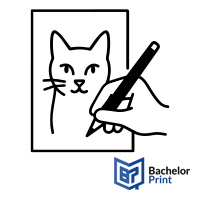
- Sketch your image directly on the black with a pencil
- Draw in reverse (mirror image), especially if the design includes text
- Indicate broad light areas (to be carved away) and dark areas (to remain raised)
➜ Many artists hatch or shade areas that’ll be removed - Plan margins and registration marks now if you’ll print multiples or colors
- Secure the block on a bench hook or non-slip mat
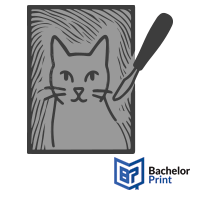
- Using U- and V-gouges, knives, and chisels, remove the non-printing areas
- Always carve away from your hands
- Rotate the block, not your wrist, to follow curves safely
- Outline key lines with a fine V-gouge
- Clear large white zones with broader U-gouges
- Keep your tools sharp
➜ Work with or across the grain thoughtfully
➜ With the grain, it reduces splintering - Across the grain can add expressive texture
- Brush away chips often to see the line quality as it develops
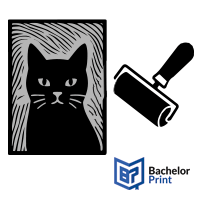
- Roll out a thin layer of relief ink on a glass/acrylic slab until it makes a soft, tacky hiss
- Load a brayer evenly and then roll ink over the raised surfaces of the block with light, multiple passes from different directions
- Avoid flooding because too much ink fills small details, while too little leads to pale-patchy prints
- Inspect under raking light
➜ Raised lines should gleam uniformly
➜ Carves recesses must remain clear
- Place printer paper carefully onto the inked block
- Burnish by hand with a baren of a spoon in overlapping circles
- Apply steady pressure or use a relief printing press for consistent impressions
- Peel a corner to proof mid-burnish if needed
- Then lift the sheet in one motion from one edge to avoid smudges
- Check the proof
➜ If light: re-ink slightly or increase pressure
➜ If heavy/blotchy: reduce ink or pressure
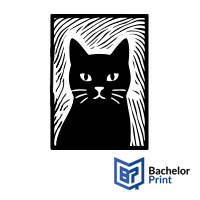
- Air-dry prints flat on drying racks or clean lines
- Avoid stacking until the surface is dry
- Once it’s fully dry, you can add the number, title, and your signature in pencil
- For color woodcuts, print one color at a time using separate blocks (or a reduction method), keeping sheets aligned with registration marks (pins, kento notches, or guides)
Notes on color woodcuts
Multiple blocks
Carve one block per color and print from light to dark, aligning each pass with registration (kento notches, pin-tabs, or jig).
Reduction method
Print the lightest color, then further carve the same block for the next color, progressively reducing the block. This saves materials and prevents reprinting earlier states.
Tools & materials
Creating a woodcut requires only a few essential tools and materials, which makes the technique both accessible and versatile. Each element influences the quality of the print.
Wood
The wood block is the foundation of every woodcut. Artists typically use fine-grained hardwoods such as pear, cherry, lime (basswood), or birch, since these woods have a smooth surface that holds sharp details without splintering. The grain pattern can add a natural texture, giving each impression a unique character.
Carving tools
To cut the image into the block, artists use a set of knives, chisels, and gouges with varying shapes and widths.
- V-gouges are used for fine outlines and intricate detail.
- U-gouges remove larger areas of wood.
- Flat chisels help clear wide spaces or refine edges.
Dull tools tear the wood instead of slicing it cleanly, which affects both control and print quality.
Printing ink
Printing ink is rolled onto the raised surfaces of the block before printing. Artists can choose between oil-based inks, which produce rich, durable colors, and water-based inks, which dry faster and clean up easily. The choice depends on the desired texture, drying time, and printing method.
Paper
Woodcut printing traditionally uses soft, absorbent papers that can pick up ink without excessive pressure. Handmade Japanese papers, such as washi, are prized for their strength and flexibility, though many Western printmakers use cotton rag or mulberry-based papers for consistent results.
Other equipment
A few additional tools make the process smoother and safer:
- Bench hook: secures the block while carving.
- Brayer (roller): for applying ink evenly to the block.
- Printing press: ensures consistent pressure for multiple prints.
- Sharpening stones: keep blades in top condition for precise cutting.
- Baren or spoon: for hand burnishing the paper onto the inked surface.
Characteristics
There are several relevant characteristics:
Bold contrast
Woodcut prints are known for strong black-and-white contrast, with crisp lines and solid areas that create a dramatic, graphic look.
Visible grain texture
The wood’s natural grain can appear in the print, adding organic rhythm and character that many artists intentionally incorporate into the design.
Distinctive hand-crafted look
Slight variations between impressions and the carved line quality give woodcuts a tangible, handmade aesthetic that feels warm and personal.
Limited tonal range, strong impact
Shading is built through line density, cross-hatching, and pattern rather than continuous tone. The result is a simplified palette with high visual impact and immediate readability.
Woodcut vs. other techniques
While woodcut is one of the earliest and most distinctive forms of printmaking, it belongs to a broader family of printing techniques that differ in tools, materials, and visual results. The table below highlights how woodcut compares to related methods in both process and appearance.
Technique
Printing type
Material
Characteristic look
Woodcut
Relief
Wood
Bold, textured lines; visible grain
Wood engraving
Relief
End-grain wood
Finer lines, more detail
Linocut
Relief
Linoleum
Smooth texture, easier to carve
Etching
Intaglio
Metal plate
Soft lines, more tonal variation
High-quality color copies from just $0.18
- Choose from different paper formats & paper weights
- Configure finishing options & add any extras you need
- Easy online ordering process with delivery to your doorstep
Learn more!
Notable artists & examples
Over the centuries, many artists have shaped the evolution of woodcut printmaking, each bringing distinct styles, techniques, and messages to the medium. The following examples highlight some of the most influential figures and their representative works.
Albrecht Dürer (1471–1528)
Active during: The German Renaissance
Dürer revolutionized the woodcut by achieving levels of detail and composition previously thought impossible, transforming it from a craft into a fine art form.
Katsushika Hokusai (1760–1849)
Active during: The Edo period in Japan
Hokusai’s expressive use of line and color in his Thirty-Six Views of Mount Fuji series made Japanese woodblock printing world-famous and inspired generations of Western artists.
Utagawa Hiroshige (1797–1858)
Active during: The Edo period in Japan
Hiroshige’s poetic landscapes and atmospheric scenes exemplify the refined color printing of the ukiyo-e tradition, focusing on everyday life and nature.
Käthe Kollwitz (1867–1945)
Active during: Late 19th and early 20th century
Kollwitz used the stark contrasts of woodcut to convey powerful emotional and political messages about war, poverty, and humanity.
Ernst Ludwig Kirchner (1880–1938)
Active during: Early 20th century, German Expressionism
A founding member of Die Brücke, Kirchner’s woodcuts feature raw energy, distorted forms, and intense emotion, reflecting the expressive potential of the medium.
M. C. Escher (1898–1972)
Active during: Mid-20th century
Escher applied mathematical precision and spatial illusion to woodcut, using the medium’s crisp lines to explore geometry, symmetry, and impossible perspectives.
Contemporary Artists (20th–21st century)
Active during: Present day
Modern artists continue to experiment with woodcut’s expressive range, combining traditional carving with digital processes, political themes, and large-scale installations.
Contemporary applications
Though centuries old, woodcut printmaking continues to inspire modern art and design with its bold lines and tactile aesthetic.
Digital simulations
Modern software now reproduces woodcut effects digitally, keeping the technique alive in visual media, animation, and digital illustration.
Woodcut-inspired tattoos
The style’s bold outlines and crosshatching have also influenced tattoo art, producing designs that echo the depth and texture of carved prints.
Graphic design & illustration
Designers often use the woodcut aesthetic for book covers, posters, and illustrations, recreating its bold contrast and handcrafted texture with digital tools.
FAQs
It’s a relief printmaking technique where an image is carved into a wooden block. The raised areas are inked and pressed onto paper to create a high-contrast print.
Yes, because linoleum is softer and easier to carve than wood. This makes linocut more accessible for beginners. However, it lacks the natural grain texture of woodcut.
Fine-grained hardwoods such as pear, cherry, lime (basswood), or birch are best.
Wood engraving uses the end-grain of the wood, while woodcut uses the side-grain.
They refer to the same technique.
- “Woodcut” describes the process and print
- “Woodblock” usually refers to the carved block itself
