
In the realms of printmaking, there are many fascinating techniques of transferring images or text onto paper and other materials. In general, there are three types to differentiate: intaglio printing, relief printing, and planographic printing. Linocut, which will be explained thoroughly in this article, belongs to the group of relief techniques that uses a specific material to carve out the image.
Inhaltsverzeichnis
Definition: Linocut
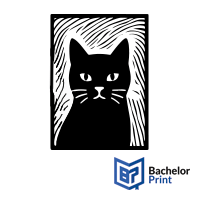
Linocut is a printing technique that belongs under the umbrella of relief printing. This means that the elevated surfaces are those where the ink is applied. In the process, the non-printed surfaces are scraped off a linoleum sheet before the ink is applied to the raised parts, which are then transferred onto the paper.
Copy and print from $0.10
- High-quality copies & prints for any project
- Vibrant color prints or sharp black & white prints
- Online copy and print services delivered straight to your door
Learn more!
Materials
As linocut is a traditionally handmade craft, several materials are needed, and the technique is typically not used in industrial bulk printing.
Linoleum
Linoleum is usually known as a floor covering, but in slightly altered forms, it is used for artistic purposes. The main ingredients are solidified linseed oil, pine resin, and cork dust, making it a very sustainable material compared to others.
Carving tools
The carving tools consist of a handle and (exchangeable) blades of different sizes and shapes. The sizes are numbered from smallest to widest, and the shape is defined as “U” or “V,” depending on the unique form of the blade.
Printing ink
The printing ink for linocut is usually oil-based ink, but water-based alternatives are also possible, especially for inexperienced artists.
Brayer/roller
The roller is used to spread the ink on the linoleum before printing, covering the elevated surfaces with an even layer of coloring.
Glass sheet
A glass sheet is necessary to evenly spread the ink on the roller, avoiding accumulations of ink in parts of the print.
Paper
Choosing the right printer paper is also essential, as it should work well with the ink and not be too thin to stay in shape even after applying the ink.
Technique
The technique of linocut follows the following procedure.
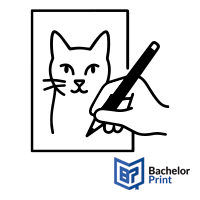
The first step is to sketch the design. Right from the start you should keep in mind that the print will mirror the image drawn on the linoleum sheet, as it gets flipped in the printing process. If the image is symmetrical, this does not pose a problem, but with non-symmetrical images, text, or numbers, remembering this fact is highly important.
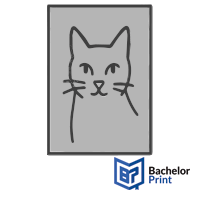
If you decide not to draw the image right on the linoleum, you can transfer it using tracing paper or other methods of transferring. A practical alternative can be the method shown in the image below, where the back of the image is covered with a pencil or crayon before the front is traced again. If you use tracing paper, you can flip the image over and already have the mirrored image. Should you use the second method, make sure to sketch the flipped image or print a mirrored version for optimal results.

Another helpful tip is to color either all areas that are to be scraped off or all the areas that will stay behind. This way you cannot miss any lines or scrape things off that were supposed to stay. Just remember if you wanted to cut away the dark or light areas!
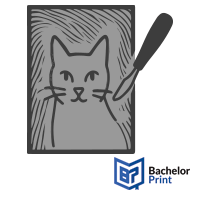
While cutting off the negative spaces, be careful. The carving tools can be very sharp, depending on the quality and the amount of usage. New artists should keep Band-Aids and sanitizer close to the working space, just in case. To avoid injuries, always scrape away from your hand and body, and, if possible, fixate the linoleum sheet on the table so you do not have to hold it in place.
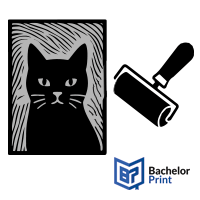
After the carving is done, it is time to apply the ink. Therefore, some ink is squeezed onto the glass sheet and spread with the roller until it forms an even layer. The brayer is then rolled across the linocut to ink all the still elevated areas. Oil-based ink is preferably used because of its smoothness, but also its slower drying process. Especially in larger prints, it can be challenging to have a moist layer of ink on the entire linoleum sheet.
Lastly, the paper is pressed onto the colored linocut. This can be done either with a press or simply by hand. For larger prints, a press is usually recommended, as it makes sure that every area gets sufficient pressure to transfer the ink onto the paper. Smaller prints can be done by hand. A tip for smaller prints is using a heavier book or even just a thicker sheet of cardboard on top to apply the pressure more evenly.
History
The history of linocut starts with the invention of linoleum in the mid-1800s by Frederick Walton, first as a floor and wall covering. Around the beginning of the 20th century, artists from Germany, Austria, and the United States discovered the material for creative purposes. After being considered a craft for beginners, students, and amateurs, more and more artists took an interest in the method and brought it to a wider audience. Even well-known artists such as Pablo Picasso took a liking to this craft and helped it rid itself of the reputation as beginner’s art.
Advantages and disadvantages
Linocut is a very intriguing technique, which is simple enough to capture even amateurs’ interest, yet versatile enough to also challenge experienced artists. Just the same it holds its advantages and disadvantages.
Advantages
- Easier to cut than wood
- Simple to make at home
- Replicable many times with the template
- Versatile through different tools or layering of colors
Disadvantages
- Hard to erase mistakes in cutting
- Templates are less durable than wood
- Expensive materials (tools, linoleum, paper, ink, and others)
High-quality color copies from just $0.18
- Choose from different paper formats & paper weights
- Configure finishing options & add any extras you need
- Easy online ordering process with delivery to your doorstep
Learn more!
FAQs
Linocut is a relief printing technique that uses linoleum sheets as a medium. The negative, non-printed spaces are then carved out of the sheet and the ink is applied to the elevated surfaces before printing them onto paper.
This depends on the materials used. Generally, a beginner’s kit can be bought for relatively little money. However, the continuous need for new linoleum sheets can become expensive, as well as more professional and precise carving tools.
Linocut can be quite expensive in the materials. Furthermore, mistakes in carving are hard to erase, and the template itself is less durable than wood, meaning that fewer prints can be made with it.
The difference is, firstly, the material. Linocut is carved into linoleum, while woodcut uses wood as the base medium, as the names suggest. Differences can also be found in the carving tools, as wood is more sturdy and thus requires sharper and more precise tools.
