
Maybe you’ve already heard of the ex libris. It’s a term that appears throughout book history and is also the name of a well-known board game. In the printing world, however, ex libris refers to a decorative bookplate, usually printed or engraved, that identifies the owner of a book. As a traditional printing term, it connects book history, early printing techniques, and personal library culture.
Ex libris explained briefly
Ex libris is a bookplate used to mark book ownership, often reflecting the owner’s status, taste, or interests. Over time, ex libris designs also became collectible artworks.
Inhaltsverzeichnis
Definition: Ex libris
Ex libris (Latin for “from the books of” or “from the library of”) refers to a bookplate: a printed or decorative label pasted inside the front cover of a book to indicate ownership.
Originally meant to prevent theft and to mark private collections, ex libris designs range from simple typographical labels to elaborate works of art created using printing techniques such as woodcuts, copper engravings, lithography, and modern digital methods.
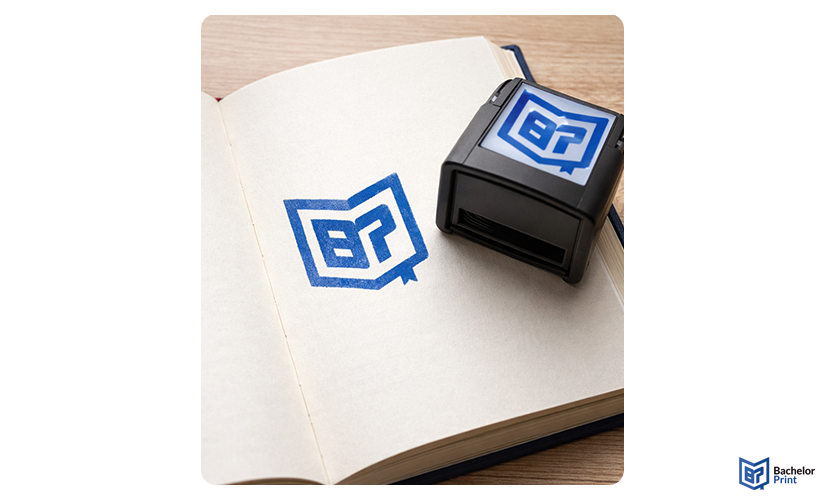
Design & elements
Typical components of ex libris include:
- Heraldic symbols, such as family crests
- Owner’s name, sometimes with a motto
- Typographical book labels for minimalist or modern styles
- Illustrative or allegorical motifs, reflecting profession, interests, or personality
Usage
Even today, book owners, collectors, and private libraries use:
- rubber stamps,
- embossing presses,
- and printed bookplates
to personalize their books and enhance the aesthetic value of their collection.
Copy and print from $0.10
- High-quality copies & prints for any project
- Vibrant color prints or sharp black & white prints
- Online copy and print services delivered straight to your door
Learn more!
History
The history of ex libris dates back to the 15th century in Germany with the advent of printing. Initially, these bookplates were a simple hand-painted coat of arms on a book’s first page to show ownership and prevent theft. With the rise of printing, they became more sophisticated, evolving into decorative labels that used processes like woodcuts and copperplate engraving. They served to display status, artistic taste, and personal interests, eventually transforming into a form of collectible art.
Early history
Pre-printing era
Before printing existed, owners of handwritten manuscripts marked possession by:
- Writing their names inside
- Adding curses against theft
- Decorating first pages with painted coats of arms
- Physically chaining books to shelves (common in monasteries)
The 15th century: First printed bookplates
With the invention of printing, the first printed ex libris appeared in Germany around 1470–1480.
One of the earliest examples is the bookplate for Hildebrand Brandenburg, hand-painted over a printed woodcut. Early bookplates politely requested borrowers to return the book.
Evolution with printing
16th century
As printing expanded, book ownership became more attainable. Ex libris turned into status symbols, with artists like Albrecht Dürer producing refined woodcuts and copper engravings.
17th and 18th centuries
Designs grew more elaborate:
- Ornate heraldry
- Decorative scrollwork
- Symbolic or architectural motifs
Bookplates increasingly reflected personal taste and the artistic styles of the era.
Modern era
Today, ex libris are:
- A niche collectible art form
- Designed in traditional or digital techniques
- Created by artists, printmakers, and collectors
- Used to personalize books or serve as artistic mini-prints
Types
The different types of ex libris can be categorized by their design, such as armorial (including family crests), portrait, allegorical, or landscape. They can also be categorized by the era or style in which they were created, including Jacobean, Chippendale, Art Deco, and Art Nouveau. The primary types reflect a combination of the owner’s personal identity and artistic trends of their time.
Allegorical
Uses symbolic figures, mythological scenes, or moral themes.
Armorial
Dominated by coats of arms, shields, heraldic animals, or family symbols.
Landscape
Natural or rural motifs; often produced by Bewick-style wood engravers.
Library/book pile
Shows library interiors, bookshelves, or stacks of books.
Portrait
Features an image of the book’s owner; famous example: Samuel Pepys.
Jacobean
(1567–1625)Scrolls, mottos, heraldry, richly decorated frames.
Chippendale
(18th century)Rococo influence: shells, elaborate frames, asymmetrical curves.
Art Nouveau
(late 19th–early 20th century)Flowing organic lines, floral elements.
Art Deco
(early 20th century)Geometric forms, bold shapes, strong contrasts (e.g., Lynd Ward).
Ribbon & wreath
Classical ornaments featuring ribbons, bows, and wreath motifs.
Copper engraving
Precise line work; common during the Renaissance.
Digital techniques
Vector graphics, digital engraving, and print-on-demand bookplates.
Etching
Acid-bitten metal plates producing expressive, textured lines.
Lithography
Flat printing process using limestone or metal plates.
Steel engraving
Extremely fine detail; prominent in the 19th century.
Woodcut
Bold contrast and carved lines; among the earliest ex libris methods.
FAQs
In art, ex libris refers to a small, artistically designed bookplate bearing the owner’s name. Many artists create ex libris as miniature collectible artworks.
Yes. Collectors and book lovers use printed labels, self-inking stamps, and embossers to personalize books or mark private libraries.
An ex libris stamp indicates book ownership and can include imagery such as coats of arms, initials, or symbolic motifs.
It literally means “from the books of” or “from the library of.” It traditionally appears above the owner’s name on a bookplate.
