
Color hue is one of the most fundamental concepts in color theory and print color management. It describes the basic color family we perceive and all intermediate hues on the color wheel. Understanding hue is essential in design and especially in printing, where consistent colors matter. This guide explains how hue works, how it differs from “color,” and why it plays such an important role in both digital and printed media.
Color hue explained briefly
Hue describes the basic attribute of a color that distinguishes it as red, blue, green, etc. In printing, hue determines the perceived color in an image and is a fundamental component of color models.
Definition: Color hue
Hue is the part of a color that tells us which basic color family we are looking at, for example, red, orange, yellow, green, blue, or purple.
➜ It answers the simple question. “What color is it?”
Hue does not describe how light, dark, dull, or vibrant the color is, only the pure color type itself.
Technical definition
In digital color models like HSL and HSV, hue is represented as an angle on a 360° color wheel. Each position on the wheel corresponds to a specific color family.
Hue does not describe brightness or saturation, only the type of color.
High-quality color copies from just AU$0.28
- Choose from different paper formats & paper weights
- Configure finishing options & add any extras you need
- Easy online ordering process with delivery to your doorstep
Learn more!
Color vs. hue
A quick comparison to avoid confusion:
Meaning
Includes
Excludes
Color
Umbrella term for any visible color
/
Hue
Pure color family
Black and white, and gray are colors, but not hues, because they have no saturation.
In print color management, hue helps determine how a color will mix when converted between RGB and CMYK.
Key concepts
To understand hue in real design and printing workflows, a few related concepts are essential.
Hues are arranged in a circular order:
Red ➜ orange ➜ yellow ➜ green ➜ cyan ➜ blue ➜ purple ➜ magenta ➜ back to red
Designers use the wheel for color harmony, contrast, and visual hierarchy.
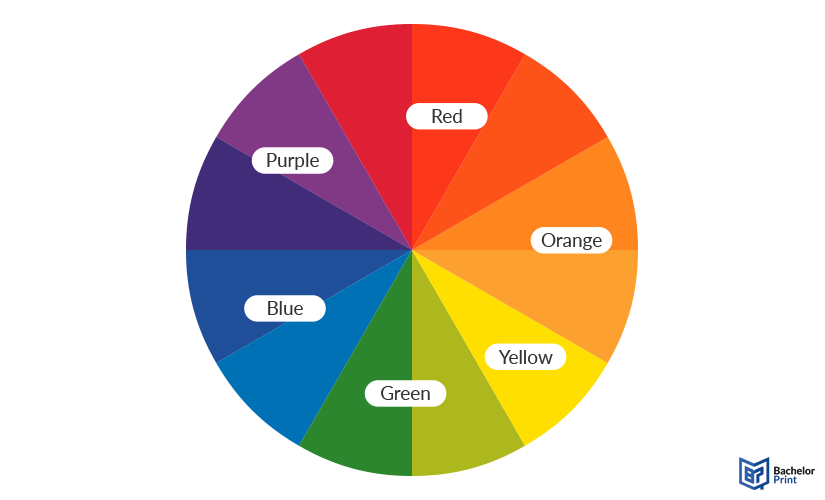
Hue is one of the three fundamental attributes used to describe any color, alongside saturation (how pure or intense a color appears) and lightness/value (how bright or dark it is).
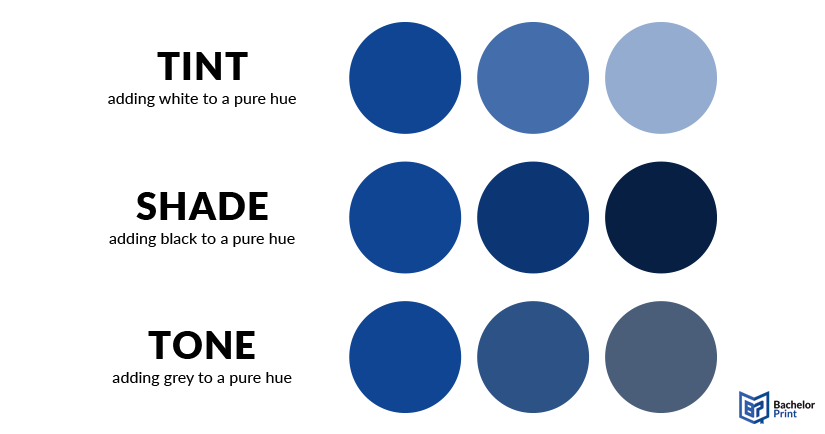
- Tints result from adding white to a hue, creating lighter variations.
- Shades are created by adding black, producing darker versions.
- Tones emerge when gray is added, reducing intensity.
In art and design, the term “hue” sometimes appears on labels like “cadmium yellow (hue).” In this context, it signals that the pigment imitates the appearance of the traditional color but uses a safer or more affordable formulation.
Connection to HSL/HSV
In both the HSL (hue, saturation, lightness) and HSV (hue, saturation, value) color systems, hue describes the same thing: the pure color family, represented as an angle on a 360° color wheel. It tells us whether a color is red, yellow, blue, green, or anything in between.
How hue works in HSL & HSV
In both systems, hue is calculated in exactly the same way from the underlying RGB values. It is an angular measurement that defines the type of color.
Typical hue positions on the color wheel include:
Red
0° and 360°
Yellow
60°
Green
120°
Cyan
180°
Blue
240°
Magenta
300°
Separation from brightness & purity
HSL and HSV were designed to isolate hue from the other two dimensions of color:
- Saturation (color purity)
- Lightness/value (brightness)
This separation makes both models more intuitive for tasks like color grading, color correction, and preparing colors for print workflows.
Achromatic colors
When a color has zero saturation or sits at the extreme ends of the lightness/value scales (pure white or pure black), it becomes achromatic. In these cases, hue is either irrelevant or undefined because the color contains no chromatic information.
Key difference between HSL & HSV
The distinction between the two models lies not in hue, but in how they define:
- Saturation
- Lightness (HSL) value/brightness (HSV)
➜ These differences influence how a selected hue appears at different brightness levels, but the hue itself does not change.
Hue & dominant wavelength
Hue is a perceptual experience. It’s the way our brain interprets color.
Dominant wavelength, on the other hand, is a physical measurement that describes the light stimulus responsible for that perception. In other words, dominant wavelength is the scientific description of the light that produces a given hue.
In color science, particularly within the CIE 1931 color space, dominant wavelength is used to characterize a color’s chromaticity. It corresponds to the wavelength of a monochromatic (pure spectral) light that, when mixed with a certain amount of white light, visually matches the color being analysed.
How we perceive color hue
Our perception of hue is shaped by a complex interaction of physical light, the environment, and the physiology of our eyes. Several factors can influence how a hue appears in different situations:
The hue we perceive depends heavily on the light source. The same object may look one color in natural daylight and a different color under incandescent or LED lighting. This phenomenon, known as metamerism, occurs because different light sources have different spectral distributions.
Hue perception also varies from person to person. Age can affect color vision, as the eye’s lens gradually yellows over time, subtly shifting how hues are perceived. Genetic factors, such as color vision deficiencies (“color blindness”), further influence how individuals interpret colors.
Colors rarely exist in isolation. The hues surrounding an object can significantly change how it appears. A color may look brighter, duller, warmer, or cooler depending on its background. This visual effect is known as simultaneous contrast.
Applications in art & design
Hue is one of the core tools artists and designers use. It influences both aesthetic decisions and strategic choices in visual communication.
Color harmony

Understanding how hues relate to one another on the color wheel is key to designing balanced and visually appealing compositions. Harmonies such as complementary, analogous, and triadic schemes help create structure, contrast, or unity depending on the desired effect.
Visual hierarchy

Hue plays an important role in directing attention. Bright or contrasting hues naturally draw the eye to focal points, while desaturated or darker tones recede into the background. Designers use this contrast to establish a clear hierarchy and guide how users navigate a page, interface, or artwork.
Branding & marketing

Brands rely heavily on hue to communicate identity and emotion. Many tech and financial companies choose blue to signal trust, stability, and professionalism. While food and retail brands use energetic hues like red and yellow because they attract attention and can stimulate appetite.
Printing services at BachelorPrint
- Individual solutions & personal support
- High print quality & fast production times
- Wide range of print products for every need
Learn more!
Psychological & cultural significance
Color hues carry powerful psychological and emotional weight. They can communicate meaning without words, but those meanings aren’t always universal.
Emotional impact
Certain hues trigger instinctive emotional reactions:
Warm hues like red, orange, and yellow often evoke energy, urgency, or passion. They can stimulate excitement and even increase heart rate.
Cool hues like blue and green are typically associated with calm, trust, and stability, often used in settings that call for reassurance or focus.
Designers use this knowledge to guide mood, tone, and viewer behaviour, especially in marketing, packaging, and visual storytelling.
Cultural context
The symbolic meaning of a hue can shift dramatically across cultures.
These differences matter. To communicate clearly and respectfully, designers and marketers must consider the cultural background of their audience when choosing hues.
FAQs
A hue is the basic color family you perceive, such as red, yellow, green, or blue. It describes the type of color before brightness or saturation are added.
Both. Green is a color, and it is also one of the main hues on the color wheel.
Color hue refers to the dominant wavelength of light that makes a color appear as a specific family, like red or blue. It distinguishes one pure color type from another.
No. “Color” is the broad term for everything we see, including brightness and saturation. “Hue” specifically describes the pure color family.
Black, white, and all shades of gray are not hues because they contain no saturation. They are achromatic colors.
