When it comes to different printer paper types, thermal printer paper definitely needs to be discussed. This type has a paper coating that darkens when coming in contact with heat, which results in black-and-white images or text without using liquid ink like inkjet printers do. In this article, we’ll focus on the different uses, types, and benefits of thermal paper and whether it is truly toxic to the touch.
Definition: Thermal paper
Thermal paper is a type of paper that works without printing ink or toner cartridges, solely with heat. This heat-sensitive paper is typically used for receipts, shipping labels, tickets, and tags and has a special coating that, when heated, turns dark. Thermal paper can come in the form of regular paper sizes or thermal roll media, which are used for printing out receipts in stores, for instance.
If you’d like to know more about the types of thermal printers and how they work, click on the button below.
Uses
Thermal paper has numerous uses. Some of them are listed below.
- Barcode labels
- Boarding passes
- Bus & train tickets
- Documents
- Fine tickets
- Invoices
- Patient wristbands
- Prescription labels
- Queue tickets
- Receipts
- Shipping labels
- Tickets
Your guide to print and production
- Information on print finishing & print processing
- Information on materials & optimal use of materials
- Information on printing processes & print production
Learn more!
Types
There are several types of thermal paper, which we’ll each explain below.
Standard thermal paper
Standard thermal paper has a basic heat-sensitive coating that forms images when exposed to a thermal printhead. It does not have additional protective layers, so it simply gives good, short-term print quality. It’s commonly used for ATM receipts, lottery tickets, and queue tickets.
Top-coated thermal paper
A top-coated or pre-coated thermal paper has an extra protective coating that is applied over the thermal layer and protects against heat and oils. This type of thermal paper is used for medical records, long-term receipts, industrial labelling, and shipping documents.
Synthetic thermal paper
Synthetic thermal paper is made from a synthetic resin base rather than cellulose paper. It’s extremely durable and resistant to chemicals, tearing, and water. It’s used for cold storage environments, industrial barcode labels, outdoor tags, and wristbands. To find out more about synthetic papers, see our waterproof paper article.
Self-adhesive thermal paper
Self-adhesive thermal paper is used for shipping labels and product labels. This type has a heat-sensitive layer on the front and an adhesive layer with a peel-off liner on the back. It can be found in portable sticker printers.
Coatings
Thermal paper consists of several layers:
- Top coat (optional)
- Thermal coating
- Pre-coat
- Base paper
- Back coat (optional)
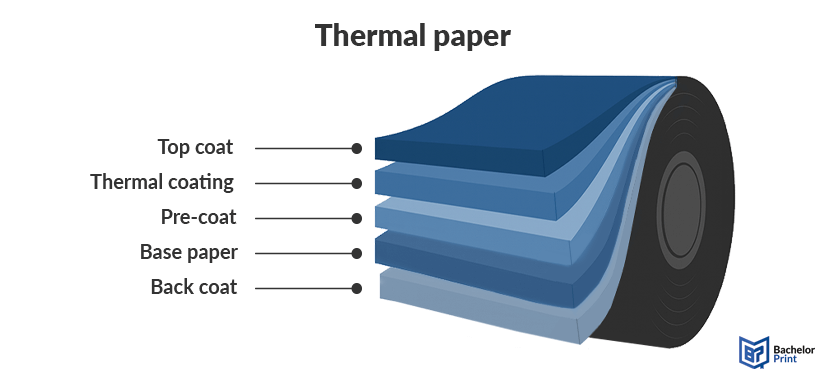
As mentioned before, the top coat is an additional layer that protects the paper from moisture and light, thereby extending its readable life.
The thermal coating consists of binders, color developers, color formers, and leuco dyes, which react to heat. This active layer creates your desired text or images.
The pre-coat layer simply helps the thermal paper work better by improving heat retention, which creates not only a smoother surface but also makes sure that the thermal coating sticks evenly.
The back coat is another optional layer that most importantly reduces static, improves roll winding, and provides a barrier against adhesive.
Printing services at BachelorPrint
- Individual solutions & personal support
- High print quality & fast production times
- Wide range of print products for every need
Learn more!
Is thermal paper toxic?
Thermal receipts and stickers are often coated with bisphenol-A (BPA) or bisphenol-S (BPS) because they react with colorless dyes when heat is applied. BPA is typically used due to its low price and effectiveness.
However, scientists have found that BPA and BPS can be absorbed through the skin and can disrupt hormones in humans and animals at low doses over extended periods. This hormone disruption can lead to health problems, including:
- Obesity
- Fertility issues
- Attention disorders
- Increased cancer risk
How do I know if my thermal paper is BPA-free?
If you no longer have the packaging of the paper at hand or can’t find a label that says “BPA free,” “phenol free,” or “BPA- and BPS-free,” you can either contact the manufacturer or do a heat exposure test. If you hold a heat source underneath the thermal paper for 2-3 seconds, it will turn black if it contains BPA, whereas BPA-free thermal paper will turn blackish-green.
Note: In the EU, a ban on BPA in thermal paper was enforced in January 2020. In the United States, a similar ban has been implemented in states including Connecticut, Minnesota, and Washington.
Benefits & disadvantages
Below, we have listed the benefits and disadvantages of thermal paper.
Pros
- Quiet printing
- Compact printer
- Low maintenance
- Easy printing process
- No ink or toner needed
- Efficient printing everywhere
- High printing accuracy & speed
Cons
- Can’t be easily recycled
- Sensitive to heat & light
- May contain BPA & BPS
- Print may fade over time
- Thermal paper is expensive
FAQs
In many countries and US states, thermal paper with BPA is prohibited due to human health concerns. So yes, it is safe to touch if you’re in those locations. However, make sure to purchase BPA-, BPS-, or phenol-free thermal paper.
Thermal paper is used for barcodes, receipts, labels, tickets, invoices, and many more.
Since thermal paper is activated through heat and not ink or toner, prints are sensitive to light and may fade over time. Additionally, the paper may contain BPA and BPS, which pose health risks to humans and animals when frequently handled.
Unlike regular paper, thermal paper is coated with special chemicals that darken when heated.
