One of the key factors that differentiates paperboard from regular printer paper is its paper weight, which is measured in GSM or pounds. This elevated paper weight makes paperboard ideal for packaging and signage. In this article, we’ll dive into what exactly paperboard is, how it is used, its types, properties, and benefits, and how it sets itself apart from cardboard. So, read on if you’d like to find out more.
Definition: Paperboard
Paperboard, also known as chipboard or carton, is a thin and light type of cardboard with a smooth surface, making it ideal for printing. While ordinary copy paper is also lightweight and flexible, paperboard is engineered to be stiff and durable, yet strong enough for structural applications, such as packaging and displays.
In most standards, paperboard is classified as paper with a caliper (thickness) generally above 0.3 mm (or 12 pt). Find out more about paper thickness by clicking on the button below.
Uses
Paperboard can be both single- or multi-ply, so it has many uses in industries all around the globe. We have listed some of them below.
- Book covers
- Cereal boxes
- Envelope sizes
- Gift cards
- Magazine covers
- Notebooks
- Packaging
- Paper plates
- Postcards
- Shoeboxes
- Tea packaging
- Tissue boxes
Hardcover with individual embossing
- Price calculator & 3D live preview
- Professional binding for thesis, dissertation, or books
- Print on demand with fast delivery right to your doorstep
Learn more!
Types
Several categories of paperboard exist, each with unique characteristics. We have listed and explained some of them below.
One type of paperboard is the coated natural kraft (CNK), which is also known as solid unbleached sulfate (SUS), and is naturally moisture-resistant.
- Made from virgin unbleached wood pulp
- Bright white and matte printing surface
- Common in beverage carriers, frozen foods, and electronics
Solid bleached sulfate (SBS) is a premium paperboard type since it has a high-end look and feel as it’s a smooth and solid white sheet.
- Made from chemically whitened wood pulp
- The most expensive paperboard option
- Common in cosmetics, frozen foods, meats, and tobacco
Coated unbleached kraft (CUK) keeps its natural brown color; however, it has a smooth, white clay coating, making it ideal for printing.
- Made from recycled (up to 20%) and unbleached virgin wood pulp
- White clay coating on top of the brown kraft paper
- Common in beer and soft drink beverage containers and retail packaging
Coated recycled paperboard (CRB), also known as clay-coated newsback (CCN) paperboard, is a popular eco-friendly choice.
- Made from recycled materials like newspaper
- White clay coating and semi-gloss finish
- Common in packaging for cereal, cake mixes, and napkins
Uncoated unbleached kraft (UUK) has a naturally brown color and is 100% eco-friendly as it is uncoated and unbleached as the name entails.
- Made from less virgin wood pulp than others
- Not ideal for printing due to textured surface
- Common in beverage carriers & heavy-duty retail packaging
Paperboard vs. cardboard
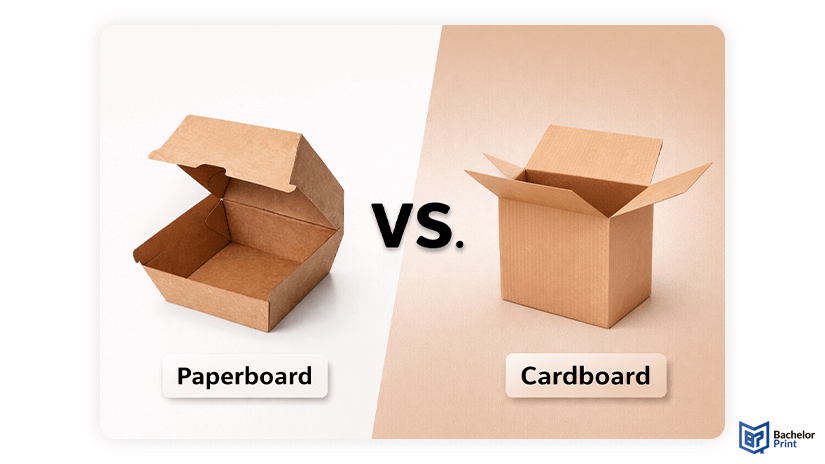
Paperboard is sometimes referred to as cardboard by people outside the paper industry, which is why it’s especially important to differentiate the two.
As mentioned in our cardboard article, paperboard is a type of cardboard that is thin and lightweight. It’s usually a single-ply board, meaning it’s a solid sheet of paperboard made from one continuous layer of fibers. However, it can also have multiple layers, e.g., as a folding boxboard (FBB), which often has three to four plies.
Cardboard is made from multiple layers of linerboard pressed together to create a sturdier material that can be used for packaging boxes. Cardboard is just a generic term for heavy paper boards, with the most common type being corrugated cardboard. It’s important to note that this is not a technical manufacturing term.
Properties
Important properties of paperboard to consider before using it for commercial purposes include the following:
- Basis weight
- Brightness
- Bulk
- Caliper
- Curl (bending of paper)
- Density
- Glueability
- Moisture content
- Ply bonding (force needed to pull it apart)
- Smoothness
- Stiffness
Paperback with your individual design
- Individual design for thesis, dissertation, or books
- Order online with fast delivery right to your doorstep
- Use a customizable pre-made design or create your own
Learn more!
Benefits of paperboard
The usage of paperboard has many benefits, here are some of them:
- Recyclable material
- Strong yet lightweight
- Ideal for high-quality printing
- Easily foldable into various shapes
- Cost-effective compared to more rigid materials
- Versatile and easily customizable
FAQs
Paperboard is used for folding cartons and retail boxes, disposable products like paper plates and cups, and also for printed items, such as book covers and game boxes.
Paperboard can also be referred to as chipboard and carton.
No. Although cardboard is often used casually for paperboard, they are not the same. Cardboard is a generic term referring to heavier multi-ply boards, meaning paperboard is a type of cardboard. When talking about cardboard, what people usually mean is “corrugated board,” which is heavier than paperboard.
Compared with corrugated cardboard, paperboard is generally lighter and less strong since corrugated board’s fluted structure makes it better for heavy loads and shipping boxes.
