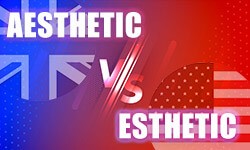
Aesthetic Or Esthetic – British vs. American English

18/03/2024 Language rules Time to read: 7min
How do you like this article?


Aesthetic-or-esthetic-01

The extensive spread of the English language across the globe has given rise to various dialects, each with its unique pronunciation and spelling variations. Achieving linguistic uniformity is essential in academic writing to ensure coherence and keep within the standards of academic integrity. The divergence between British English vs. American English is the most prominent one, entailing notable spelling differences. We will delve into the case of β€œaesthetic” and β€œesthetic” below.

β€œAesthetic” or β€œesthetic”

β€œAesthetic” or β€œesthetic” can be adjectives and nouns. Used as an adjective, it describes something that pertains to the appreciation of beauty or the appearance of something. It refers to the principles, guiding the work of an artist or the work of art itself.

When β€œaesthetic/esthetic” is used as a noun, it refers to a particular taste for what is pleasing to the senses, especially sight. An β€œaesthetic/esthetic” typically revolves around a set of principles underlying and guiding the work of a certain artist or artistic movement. It can also be attributed to a branch of philosophy that deals with the nature of art, beauty, and taste.

These terms are both variants of the same word, varying mainly in spelling between British and American English, with β€œaesthetic” with an β€œa” in the initial position being the more common form worldwide.

Aesthetic-or-esthetic-UK-flag

British English

aesthetic

Β 

Aesthetic-or-esthetic-US-flag

American English

aesthetic

esthetic

Both β€œaesthetic” and β€œesthetic” are spelled correctly, but are conventional in different English variants, like British and American English. While β€œaesthetic” with an extra β€œa” at the beginning is accepted in both English variants, β€œesthetic” with the β€œa” omitted is only correct in the American spelling. It is integral to stick to the English variant you choose throughout your whole paper to maintain academic integrity and credibility. In other words, you must not alternate between different English variants.

Note: β€œAesthetic” is the more common spelling in both British English and American English in the context of beauty, arts, and the philosophical study of what is pleasing to the eye. It is universally recognized and preferred in academia, philosophy, and overall use across English speakers.

Examples of using β€œaesthetic” and β€œesthetic” as a noun

The following examples showcase the correct use of the different spellings of β€œaesthetic/esthetic” as a noun in sentence structures.

  • British English: β€œAesthetic”
  • American English: β€œAesthetic/esthetic”
Aesthetic-or-esthetic-examples-noun-UK-flag
  • The aesthetic of the gallery appealed to his taste.
  • The new cafΓ© downtown has a rustic aesthetic.
  • Her music blends a vintage aesthetic with modern beats.
Aesthetic-or-esthetic-examples-noun-US-flag
  • The aesthetic/esthetic of the gallery appealed to his taste.
  • The new cafΓ© downtown has a rustic aesthetic/esthetic.
  • Her music blends a vintage aesthetic/esthetic with modern beats.

Examples of using β€œaesthetic” and β€œesthetic” as an adjective

Used as an adjective, β€œaesthetic/esthetic” takes on a different placement in sentence structures, as shown in the examples below.

  • British English: β€œAesthetic”
  • American English: β€œAesthetic/esthetic”
Aesthetic-or-esthetic-examples-adjective-UK-flag
  • She has an aesthetic sense to create stunning paintings.
  • Their wedding was planned with aesthetic precision.
  • The aesthetic design of the building has natural lights.
Aesthetic-or-esthetic-examples-adjective-US-flag
  • She has an aesthetic/esthetic sense to create stunning paintings.
  • Their wedding was planned with aesthetic/esthetic precision.
  • The aesthetic/esthetic design of the building has natural lights.

An alternative spelling of the adjective β€œaesthetic/esthetic” is β€œaesthetical” or β€œesthetical.” Both forms are adjectives that describe something related to art or the appreciation of beauty. While β€œaesthetic/esthetic” is the preferred form in both British and American English, β€œaesthetical/esthetical” is occasionally used as well. The following presents a few examples of using the word correctly in both English variants.

  • British English: β€œAesthetical”
  • American English: β€œAesthetical/esthetical”
Aesthetic-or-esthetic-examples-adjective-UK-flag
  • She has an aesthetical sense for paintings.
  • Their wedding was planned with aesthetical precision.
  • The aesthetical design of the building has natural lights.
Aesthetic-or-esthetic-examples-adjective-US-flag
  • She has an aesthetical/esthetical sense for paintings.
  • Their wedding was planned with aesthetical/esthetical precision.
  • The aesthetical/esthetical design of the building has natural lights.

β€œAesthetic” or β€œesthetic” as an adverb

When β€œaesthetic/esthetic” is used as an adverb to modify adjectives, verbs, or other adverbs, it takes on the form of β€œaesthetically” or β€œesthetically.” The following shows examples of using the adverb correctly.

  • British English: β€œAesthetically”
  • American English: β€œAesthetically/esthetically”
Aesthetic-or-esthetic-examples-adverb-UK-flag
  • The painting was aesthetically pleasing.
  • The building was aesthetically designed.
  • She arranged the flowers aesthetically in the vase.
Aesthetic-or-esthetic-examples-adverb-US-flag
  • The painting was aesthetically/esthetically pleasing.
  • The building was aesthetically/esthetically designed.
  • She arranged the flowers aesthetically/esthetically in the vase.

β€œAesthetic” or β€œesthetic” as a verb

Though not commonly used, the related verb for β€œaesthetic/esthetic” is β€œto aestheticise” or β€œto aestheticize /estheticize.” The verb has the function of conveying the act of applying aesthetic principles to something, or the process of rendering something in terms of its aesthetic values. The following examples shed more light on using it in context.

  • British English: β€œTo aestheticise”
  • American English: β€œTo aestheticize/estheticize”
Aesthetic-or-esthetic-examples-verb-UK-flag
  • The artist aestheticises his paintings.
  • They hired a designer to aestheticise their interiors.
  • Her poetry aestheticises sorrow.
Aesthetic-or-esthetic-examples-verb-US-flag
  • The artist aestheticizes/estheticizes his paintings.
  • They hired a designer to aestheticize/estheticize their interiors.
  • Her poetry aestheticizes/estheticizes sorrow.

β€œAesthetic” or β€œesthetic” in the β€œ-ing” form

The verb β€œaestheticise/aestheticize/estheticize” can be inflected in the β€œ-ing” form to indicate a gerund or a present participle. The sentences below show examples following the spelling conventions of British and American English.

  • British English: β€œAestheticising”
  • American English: β€œAestheticizing/estheticizing”
Aesthetic-or-esthetic-examples-ing-form-UK-flag
  • Aestheticising the room creates peace in the class.
  • The approach to aestheticising the office is smart.
  • The filmmaker is aestheticising the realities of life.
Aesthetic-or-esthetic-examples-ing-form-US-flag
  • Aestheticizing/estheticizingΒ the room creates peace in the class.
  • The approach to aestheticizing/estheticizing the office is smart.
  • The filmmaker is aestheticizing/estheticizing the realities of life.

β€œAesthetic” or β€œesthetic” in the β€œ-ed” form

When the verb β€œto aestheticise/aestheticize/estheticize” is inflected in the β€œ-ed” form, it implies the past tense or past participle. The examples below illustrate the correct use of it in British and American English.

  • British English: β€œAestheticised”
  • American English: β€œAestheticized/estheticized”
Aesthetic-or-esthetic-examples-ed-form-UK-flag
  • The novel’s description was deeply aestheticised.
  • Her fashion blog aestheticised everyday wear.
  • The exhibition featured aestheticised photographs.
Aesthetic-or-esthetic-examples-ed-form-US-flag
  • The novel’s description was deeply aestheticized/estheticized.
  • Her fashion blog aestheticized/estheticized everyday wear.
  • The exhibition featured aestheticized/estheticized photographs.

β€œAesthetic” or β€œesthetic” in the plural form

The meaning of β€œaesthetic/esthetic” slightly changes when it is used in its plural form, β€œaesthetics/esthetics.” The plural is commonly used to refer to the general study or philosophy of beauty in arts, literature, and nature. If you describe something about the appreciation of beauty or a specific taste, the singular version is the correct choice. The following examples show using β€œaesthetics/esthetics” in sentences.

  • British English: β€œAesthetics”
  • American English: β€œAesthetics/esthetics”
Aesthetic-or-esthetic-examples-plural-UK-flag
  • Her fashion design is known for its innovative aesthetics.
  • The restaurant’s decor matches its culinary aesthetics.
  • The magazine’s layout reflects modern aesthetics.
Aesthetic-or-esthetic-examples-plural-US-flag
  • Her fashion design is known for its innovative aesthetics/esthetics.
  • The restaurant’s decor matches its culinary aesthetics/esthetics.
  • The magazine’s layout reflects modern aesthetics/esthetics.

FAQs

β€œAesthetic” and β€œesthetic” are essentially the same word with the same meaning but refer to the different spellings of British and American English. While β€œaesthetic” is universally recognized, β€œesthetic” is only common in American English.

In American English, β€œaesthetic” and β€œesthetic” are accepted ways of spelling. However, β€œaesthetic” is the preferred version.

β€œAesthetic” or β€œesthetic” defines a particular taste for what is pleasing to the eye. In the context of β€œmy aesthetic/esthetic,” it refers to your personal style, look, or how you approach situations in terms of what you perceive as compelling and beautiful.

In Canada, β€œaesthetic” is the preferred version. β€œEsthetic” is a possible spelling in the United States.

Three commonly known aesthetics are imitationalism, formalism, and emotionalism.

Print Your Thesis Now
Printing your thesis with BachelorPrint guarantees every Australian student to benefit from numerous advantages:
  • βœ“ Free express delivery
  • βœ“ Individual embossing
  • βœ“ Selection of high-quality bindings

to printing services

How do you like this article?
By

Salome Stolle

Β 
About the author

Salome Stolle works as the brand manager for the English market at BachelorPrint. Throughout her 12-year residency in Denmark, she completed her International baccalaureate and Master’s in Culture, Communication, and Globalization with a specialization in media and market consumption. Through this experience, she has gained advanced competencies in academic writing and a high proficiency level in the English language. With her passion for writing, she does not only deliver well-written content but also strives to adjust to the students’ demands.

Show all articles from this author
About
BachelorPrint | #1 Online Printing Service
For Australian Students

BachelorPrint is an online printing service specialised in printing and binding academic papers, theses, and dissertations. Offering a wide arrange of bindings and configurations, BachelorPrint aims to enable every Australian student to receive its desired binding. Additionally, BachelorPrint offers hundreds of educational articles on various topics regarding academic writing in its Study Guide, supporting students with writing their thesis or dissertation.


Cite This Article

Bibliography

Stolle, S. (2024, March 18). Aesthetic Or Esthetic – British vs. American English. BachelorPrint. https://www.bachelorprint.com/au/british-english-vs-american-english/aesthetic-or-esthetic/ (retrieved 06/05/2026)

In-text citation

Parenthetical
(Stolle , 2024)
Narrative
Stolle (2024)

Bibliography

Stolle, Salome. 2024. "Aesthetic Or Esthetic – British vs. American English." BachelorPrint, Retrieved May 06, 2026. https://www.bachelorprint.com/au/british-english-vs-american-english/aesthetic-or-esthetic/.

In-text citation

Parenthetical
(Stolle 2024)

Bibliography

Salome Stolle, "Aesthetic Or Esthetic – British vs. American English," BachelorPrint, March 18, 2024, https://www.bachelorprint.com/au/british-english-vs-american-english/aesthetic-or-esthetic/ (retrieved May 06, 2026).

Footnotes

Short note
Stolle, "Shortened title."

Bibliography

Stolle, Salome: Aesthetic Or Esthetic – British vs. American English, in: BachelorPrint, 18/03/2024, [online] https://www.bachelorprint.com/au/british-english-vs-american-english/aesthetic-or-esthetic/ (retrieved 06/05/2026).

Footnotes

Full note
Stolle, Salome: Aesthetic Or Esthetic – British vs. American English, in: BachelorPrint, 18/03/2024, [online] https://www.bachelorprint.com/au/british-english-vs-american-english/aesthetic-or-esthetic/ (retrieved 06/05/2026).
Direct quote
Stolle, 2024.
Indirect quote
Stolle, 2024.

Bibliography

Stolle, Salome (2024): Aesthetic Or Esthetic – British vs. American English, in: BachelorPrint, [online] https://www.bachelorprint.com/au/british-english-vs-american-english/aesthetic-or-esthetic/ (retrieved 06/05/2026).

In-text citation

Direct quote
(Stolle, 2024)
Indirect quote
(Stolle, 2024)
Narrative
Stolle (2024)

Bibliography

Stolle, Salome. "Aesthetic Or Esthetic – British vs. American English." BachelorPrint, 18/03/2024, https://www.bachelorprint.com/au/british-english-vs-american-english/aesthetic-or-esthetic/ (retrieved 06/05/2026).

In-text citation

Parenthetical
(Stolle)
Narrative
Stolle

Bibliography

Number. Stolle S. Aesthetic Or Esthetic – British vs. American English [Internet]. BachelorPrint. 2024 [cited 06/05/2026]. Available from: https://www.bachelorprint.com/au/british-english-vs-american-english/aesthetic-or-esthetic/


Our posts on other topics