Possessive pronouns are a fundamental aspect of grammar, playing a crucial role in both everyday communication and academic writing. These types of pronouns help streamline sentences by showing ownership without repeating the noun. In this article, we’ll explore the definition, usage, and importance of possessive pronouns, while also providing you with examples and practice sheets to deepen your fundamental understanding of English grammar.
Definition: Possessive pronouns
Possessive pronouns are words that express ownership or different kinds of possession, functioning independently without accompanying nouns. These pronouns serve to replace nouns that have already been mentioned prior or are understood from context, thereby avoiding repetition and redundancy and clearly indicating who or what owns something. Possessive pronouns hereby can be used as either subjects or objects, and match the number of the owner and not the owned object(s).
List of possessive pronouns
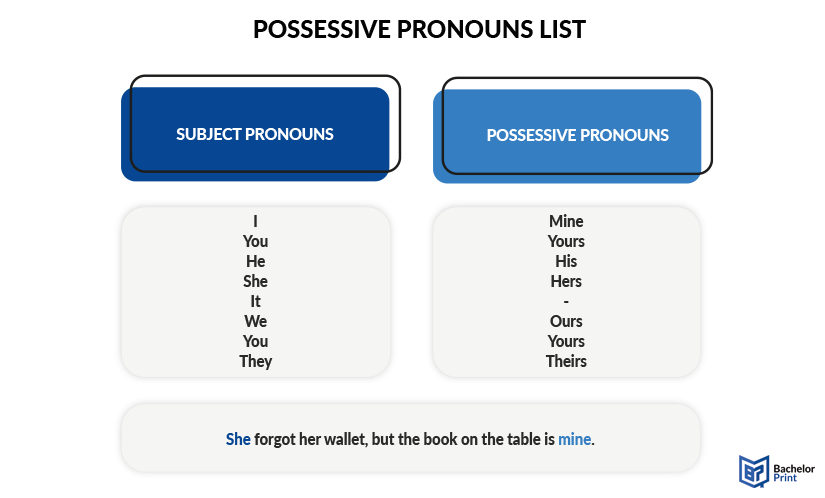
To further your understanding of this type of pronoun, we’ll provide you with an overview of all kinds of possessive pronouns. These can be divided into three types: singular, plural, and gender-neutral.
Singular
In total, there are five different singular subject pronouns that refer to only one person or thing. They act as the subject of a sentence and perform the action of the verb.
| Subject pronouns | Possessive pronouns |
| I | Mine |
| You | Yours |
| He | His |
| She | Hers |
| It | - |
Note: It’s important to note that “its” as a possessive pronoun is archaic and rarely used by native English speakers. It is, however, common to encounter “its” in old literature such as Shakespeare’s Henry VIII.
Plural
There are three different types of plural pronouns that refer to more than one person or thing.
| Subject pronouns | Possessive pronouns |
| We | Ours |
| You | Yours |
| They | Theirs |
Gender-neutral
The tables above list the words hers and his that are used to specify a person’s or an animal’s gender. While these two gender-specific pronouns are commonly used, there are others available that do not imply a particular gender. These can be used for either nonbinary people or a person’s or animal’s gender whose identity you don’t know yet. In this case, you can use theirs, which not only exists as a plural possessive pronoun, but also as a singular neutral one. One’s with an apostrophe can be used as well, as it is an indefinite personal pronoun.
Another important gender-neutral pronoun to mention is whose, which queries ownership and is used universally across context without implying any gender. Not only does it function as a possessive form of the pronoun who, but it also functions as a determiner, describing a person or thing through more information, and as an interrogative pronoun. Thus, it can function as a stand-in for a singular noun, like a pronoun, but it can also describe ownership of a noun, like an adjective. Here are a couple of examples of how to use “whose.”
Note: We do not use apostrophes with possessive pronouns!
To aid your comprehension, we have provided a visual representation of the above-mentioned information.
Dependent vs. independent
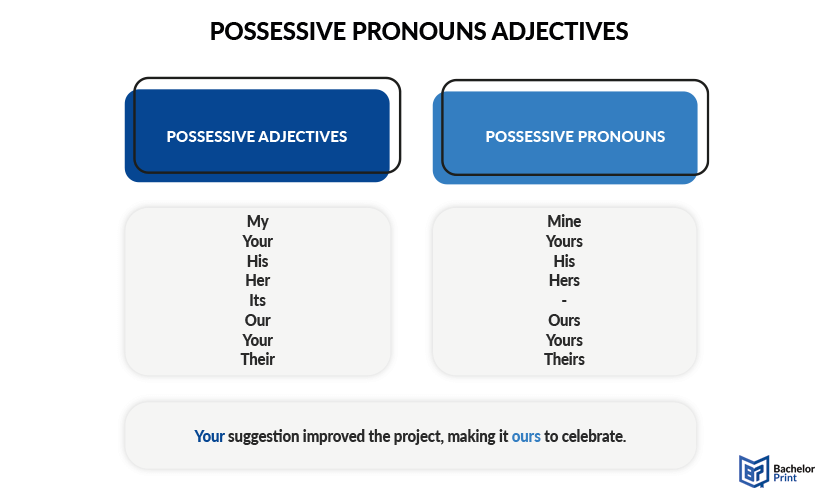
Many writers mistake possessive pronouns with possessive adjectives. While the former replaces nouns, the latter describes them. In this paragraph, we’ll compare both dependent and independent words of ownership or association by further explaining their functions and providing numerous examples.
Dependent
There are eight dependent possessive pronouns, also called possessive determiners or possessive adjectives. Those are my, our, your, his, her, its, their, and whose. They function more like adjectives because they modify nouns directly as they are used before a noun or a noun with an adjective modifier, and cannot stand alone. Possessive adjectives are not only used to show ownership, but also in the sense of a direct relationship, e.g., with people, countries, and jobs.
Independent
Independent possessive pronouns, on the other hand, can stand alone as they replace a noun and indicate possession. Those are the ones we’ve already gone through in the preceding paragraph.
To assist your learning, we have created an illustration depicting the information above.
Double possessives
Double possessives, also known as double genitives, are a unique grammatical construct that emphasizes a particular type of ownership or association. Commonly found in the study of languages such as German and Russian, double possessives enrich the language by combining the preposition “of” with a possessive pronoun or a possessive noun (as seen in the next section). We’ve provided several examples below.
Possessive apostrophes
An important rule to remember is that we never use apostrophes with possessive pronouns. A common mistake is the use of commonly confused words, especially it’s vs. its. “It’s” with an apostrophe is the shortened form of “it is/has,” whereas “its” is a rarely used word of literal ownership. “Its” is significantly more used as a possessive adjective than a pronoun.
We have already brushed over the subject of the possessive term “one’s,” which is written with an apostrophe and can be confused with “ones.” An easy way to figure out which one to use is to replace the word with “anyone’s.” If it makes sense grammatically, you need an apostrophe as well.
Another common spelling mistake is who’s vs. whose, where “who’s” is a contraction for “who is/has.” We do, however, use apostrophes of ownership with names, even when they end with an “S.” Below, you’ll find several examples to demonstrate the right and wrong use of apostrophes.
“It’s” is a contraction for “it is” or “it has,” which doesn’t make sense in this sentence. The correct choice is the possessive form “its.”
In this example, “hers” is the correct possessive form because there are no apostrophes with possessive pronouns.
Both examples indicate a relationship using a double possessive. In the first one, Martina is the subject and in the second one it is “I.”
“Who’s” is a contraction for “who is” or “who has,” making “whose” the correct possessive form.
The individual is referred to as “one,” so an apostrophe is needed to indicate that the business belongs to “one.”
- ✓ 3D live preview of your individual configuration
- ✓ Free express delivery for every single purchase
- ✓ Top-notch bindings with customised embossing
Tips
We’ll wrap up this article by giving you tips on the topic of possessive pronouns and what you should look out for when using them.
Clarity
Make it clear what noun or noun phrase is being substituted by a possessive pronoun. Readers and listeners can often use context to determine what is being referred to, even if it isn’t explicitly stated.
No apostrophe
It’s essential to remember that you don’t use an apostrophe with possessive pronouns and possessive adjectives, such as “its.”
Unknown subject
Occasionally, you might refer to people whose gender you don’t know yet, in this case, we use the neutral pronoun “they.” The possessive pronoun for it is “their,” which can also be used to include all genders.
Possessive adjectives
Mistaking a pronoun with a possessive adjective can lead to many errors, so make sure to know the difference between them. Possessive adjectives stand before a noun, while possessive pronouns replace them.
Double possessives
When it comes to double possessives or double genitives, you generally don’t use them with inanimate objects in most contexts. It emphasizes a personal connection or belonging.
FAQs
In English Grammar there’s: mine, yours, his, hers, ours, yours, and theirs.
- This laptop is mine.
- Is that car yours?
- I found a wallet; I think it’s hers.
- Are these books theirs?
- The decision was his to make.
The use of double possessives or double genitives involves combining the preposition “of” with a possessive pronoun or a possessive noun. It adds emphasis or specificity to expressions or possessions.
Examples
- He’s a colleague of hers.
- They’re a friend of John’s.
- She’s a student of mine.
- That’s her dog.
- It’s our garden.
- This is their cousin.
- My husband is in jail.
- His grandma is doing well.
