
Have you ever heard somebody say, “Let the cat out of the bag,” and wondered what it meant? This expression is a euphemism, meaning “revealing a secret,” softening the sharp edges of truth with a touch of whimsy. They guide us through delicate topics with grace and levity, making the tough talks just a bit easier to handle. In academic writing, the use of this device is generally avoided to maintain clarity, precision, and objectivity in presenting information.
Definition: Euphemism
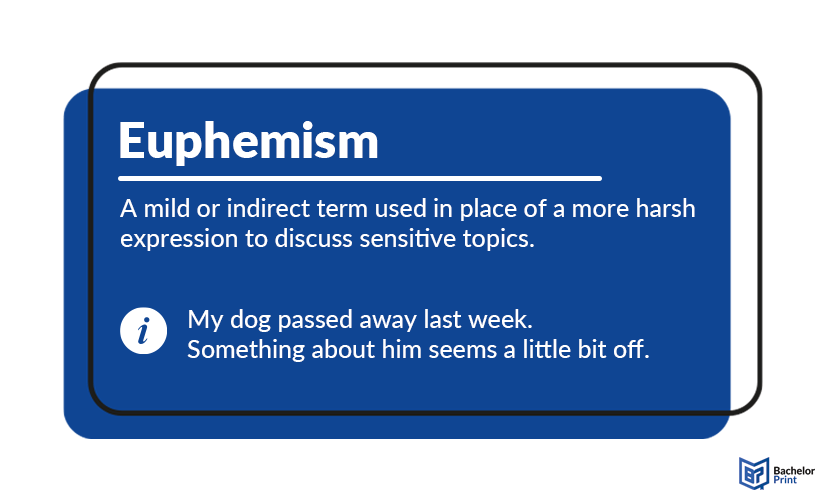
The term euphemism, also called “minced oath,” is a stylistic device in the English language that replaces words or phrases considered harsh, impolite, or unpleasant with more gentle, indirect, or vague expressions. This stylistic device can take different forms and is used to discuss sensitive or taboo topics, e.g., disability or death, in a more socially acceptable way. It functions as a noun in the English language and is the counterpart to dysphemism, which intentionally uses derogatory or unpleasant terms to shock or offend.
Etymology
The origin of euphemism is derived from the Greek root word “euphemismos,”(from euphemizein) meaning “auspicious words” or “sounding good.” The prefix “eu-” translates to “good” or “well” and “pheme” refers to “speaking” or “prophetic speech.” Thus, “euphemism” literally translates to “good speaking.” This etymology reflects the purpose of this device: to replace words or phrases that might be considered harsh or unpleasant with more agreeable or inoffensive terms.
Examples of euphemisms
This stylistic device comes in various forms and serves different purposes in language, such as mitigation or avoidance of unpleasant topics. A multitude of examples is provided below:
Both examples convey information about the neighbor’s condition, with the first directly naming the medical condition and the second using a softer, less specific term.
These sentences provide a clear illustration of how a more socially acceptable phrasing and a direct statement can be used to describe the same employment situation.
This example shows the use of political euphemisms and direct statements to describe the same situation, where innocent people have passed away.
Types of euphemism
There are types of euphemism for nearly every tricky situation; whether it’s softening a tough blow, making sure we’re being kind to everyone, or just trying to keep things light. They can be categorized as follows:
This type is used to cushion the blow of harsh truths, like saying “passed away” instead of “died.” It simultaneously creates a more pleasant image in mind when being used.
This type is used to downplay the seriousness or magnitude of a situation, often to inject humor, maintain modesty, or simply soften the delivery of information.
As the name already implies, this type is used to replace an explicit description, like going to the bathroom, with a more indirect expression.
Online communication, with its blend of informality, anonymity, and rapid evolution, has given rise to its set of euphemisms. These types of euphemisms often serve to soften, obscure, or humorously refer to behaviors, practices, and phenomena of the digital age. They are oftentimes referred to as “algospeak” and used to evade automated online moderation techniques used on Meta or TikTok. Generally, it refers to the creative use of alternative words or phrases on social media.
COVID-19
“Miss Rona” is a euphemistic term for the coronavirus (COVID-19), used to lighten the conversation about the pandemic by personifying the virus. This term became popular on social media as a way to discuss COVID-19-related topics in a less direct manner, since many people suffered severely.
FYP
“FYP” stands for “For You Page” on TikTok, referring to the personalized feed of content recommended to users based on their interests and interactions. It is often used by users with the hope of reaching a wider audience through using the hashtag “#FYP.”
These terms are informal and used within a particular group or culture to address topics that might be considered too direct, sensitive, or taboo for straightforward discussion.
Doublespeak expressions (also known as bureaucratic euphemisms) involve the use of language that deliberately obscures, disguises, distorts, or reverses the meaning of words. This is done to make an unpleasant, problematic, or inconvenient reality appear more acceptable or to avoid addressing the issue directly.
Religious discussions about death, the divine, or moral and ethical judgments need to be addressed with reflecting respect for all religious beliefs and practices.
Purpose
Euphemisms serve many purposes in language and communication, reflecting the nuanced ways humans interact and navigate social, cultural, and personal sensitivities. Their use can vary widely depending on context, audience, and intent.
Mitigation
This stylistic device is oftentimes used to downplay the severity or seriousness of actions or situations. This can be particularly evident in political or corporate language, where actions might be described to minimize perceived negativity or responsibility.
Avoidance
Sensitive topics, such as bodily functions or personal matters, might be uncomfortable or deemed inappropriate for direct discussion in certain contexts.
Comfort
In personal or emotional contexts, this device can offer comfort by framing a situation in less offensive, and more gentle words. This might be needed in sensitive conversations about illness, loss, or personal changes.
Rhetoric
In academic writing, euphemism rhetoric refers to the deliberate use of mild or indirect language to convey sensitive or unpleasant information. They are often employed to soften the impact of potentially offensive or harsh statements, making them more palatable to the reader while maintaining professionalism.
Controversial use
A controversial use typically occurs when they’re used to hiding or minimizing the seriousness of certain actions or events.
A term used as a handy euphemism by some to describe methods of torture or coercive interrogation tactics, such as waterboarding.
This word is used to describe medical treatments and therapies that are not supported by scientific evidence.
Formation methods
The formation of euphemisms involves various linguistic processes and methods. The most common ways to form them are illustrated below:
Substitution
This method exemplifies the most straightforward method involving substituting a less offensive word or phrase for a more direct or potentially offensive one.
Metaphor
Euphemisms typically employ figurative language to convey sensitive or unpleasant topics indirectly. This method leans on metaphors, where you use a word or phrase for something it doesn’t literally mean, to make tough topics easier to talk about.
Rephrasing/circumlocution
Instead of using direct terms, speakers may opt for rephrasing or circumlocution to convey the same meaning in a less confrontational manner. This method involves using longer or more complex phrases to soften the impact of the underlying concept.
Abbreviations and acronyms
They can be formed by using abbreviations and acronyms to create a more neutral term. This is because abbreviations do not carry the same weight or stigma as the full term, making it a softer way to refer to conditions. An example is illustrated below:
Foreign languages
These words might also be borrowed from foreign languages or cultures to introduce novel or less confrontational terms for sensitive topics. These borrowed terms may retain their original meanings and undergo semantic adaption to suit the context.
Metonymy
Metonymy is a figure of speech where one term is substituted with another that is closely associated with it. In the context of euphemism, metonymy can be used to replace a harsh or taboo term with a milder one.
In this case, “the White House” is used metonymically to refer to the President of the United States. Instead of directly stating “the President announced,” the term “the White House” is used, which is less direct and may soften the impact of the announcement.
Litotes
Litotes is also a stylistic device that serves to emphasize a statement by expressing it through understatement, typically by negating its opposite. This approach often creates a modest tone or downplays achievements.
Phonetic modification
Phonetic modification involves altering the pronunciation of words to make them sound less explicit.
British euphemisms
British English is rich in euphemisms, often used to soften the impact of potentially sensitive or uncomfortable topics. Below, you’ll find a table with a multitude of British euphemisms.
| British | Meaning |
| Like a fart in a colander | Describing something or someone that is chaotic, or falling apart |
| As much use as a chocolate teapot | Used to describe something or someone utterly useless or ineffective |
| Not the sharpest tool in the shed | A humorous way of saying someone is not very intelligent |
| As happy as a pig in shit | Describing someone who is thrilled or content in their situation |
| Tired and emotional | Notorious British euphemism for “drunk” |
| To be between jobs | To be unemployed |
- ✓ 3D live preview of your individual configuration
- ✓ Free express delivery for every single purchase
- ✓ Top-notch bindings with customised embossing
FAQs
Examples
- “Passed away” instead of “died”
- “Vertically challenged” instead of “short”
- “Senior citizen” instead of “old person”
The word “euphemism” refers to a mild or indirect word or expression for one that is considered to be too harsh or blunt. The term itself comes from the Greek roots “eu,” meaning “good,” and “pheme” meaning “speech” or “expression.” Literally translated, the stylistic device means “good speech” or “speaking well.”
Euphemisms soften harsh or taboo language, aiming for social tact. Metaphors, however, compare unrelated things and add depth and creativity to written and conversational language.
In academic contexts, it’s generally best to avoid this stylistic device, as it requires clear and precise language in writing to communicate ideas effectively. Its use may obscure meaning and introduce ambiguity, which can undermine the clarity and credibility of your writing. Instead, you should always opt for straightforward language that accurately conveys your arguments.
Euphemisms can impact communication by softening harsh language, maintaining social harmony, and avoiding offense. However, they can change the meaning of words if overused or misapplied.
A commonly used euphemism is “passed away” to refer to someone who has died.
