Portrait format refers to a vertical page orientation where the height is greater than the width. Commonly used for documents like resumes, books, and portraits, this format is essential in various printing terms. In this guide, we’ll cover its definition, common sizes, and when to choose portrait format for your printing projects.
Definition: Portrait format
Portrait format refers to a vertical orientation where the height of the page is greater than the width. This format is commonly used for subjects that are taller than they are wide.
It is also the standard layout for documents like letters, resumes, and books.
Affordable document printing from £0.08
- Crisp text, vibrant colors & multiple paper choices
- No need to visit a shop; simply order online anytime
- Print documents, copies & reports with professional quality
Learn more!
Portrait vs. landscape format
While portrait format is ideal for documents that require a vertical structure, landscape format suits wider layouts. Let’s explore their differences, practical implications, and when each format is most efficient.
Structural difference
Width-to-height ratio
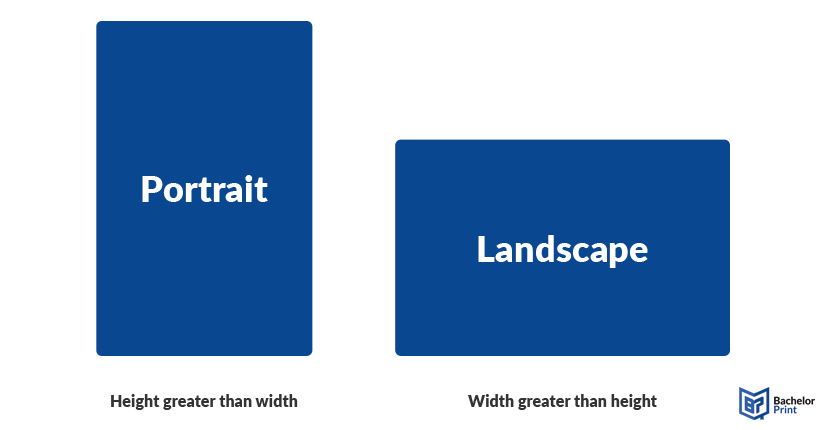
Portrait format has a taller height than width, while landscape format has a wider width than height.
Visual axis and reading flow
Portrait aligns with vertical reading progression, while landscape focuses on horizontal movement.
Practical implications
When portrait is more efficient:
- Books and reports
- Text-heavy documents
- Standard office printing
- Filing and archiving systems
When landscape improves usability:
- Panoramic images
- Large-format displays
- Presentations and slide decks
- Wide tables and comparison charts
Quick comparison
Feature
Portrait
Landscape
Orientation
Vertical
Horizontal
Visual emphasis
Height
Width
Typical uses
Books Letters
Slides Banners
Dimensions
Understanding the different dimensions for portrait format is crucial for selecting the right size for your project, whether it’s for printing, photography, or digital content.
Common aspect ratios
- 9:16 = Common for TikTok, Instagram Reels, and Stories.
- 4:5 = Frequently used for Instagram feed posts.
- 2:3 = Typical for DSLR portrait shots.
- 3:4 = Standard for tablet displays and mobile photography.
DIN/ISO paper sizes
- A4 (210 × 297 mm) = The most commonly used paper size for portrait-format printing.
- A3 (297 × 420 mm) = Used for larger documents, posters, and presentations.
US sizes
- Letter (8.5 × 11 inches) = Standard for office documents in portrait format.
- Legal (8.5 × 14 inches) = Slightly taller, often used for legal documents.
- Tabloid (11 × 17 inches) = Common for larger publications, including newspapers.
Pros & cons
Like any format, portrait comes with both advantages and drawbacks. Here’s a breakdown of the pros and cons.
Pros
- Easy to shop
- Efficient for text
- Professional aesthetic
- Focuses on the subject
Cons
- Distance constraints
- Not ideal for panoramic shots
- Less versatile for presentations
- Limited space for side-by-side content
Online A4 printing for £0.08
- Quick production times & reputable delivery
- Professional A4 prints for personal and business use
- Configure the printing specifications for your A4-size prints
Learn more!
When to choose
Choosing the right format for your project depends on the content, context, and how your audience will interact with it.
Humans prefer shorter line lengths for easier reading. Portrait orientation, like an A4 page, allows the eye to track content smoothly from left to right without getting “lost” in long lines.
Standard forms: It’s the industry standard for resumes, letters, and reports, ensuring documents are easily read and understood.
When holding printed materials, such as menus, brochures, or flyers, portrait is more comfortable as it allows for a stable grip with one hand.
Pocket/bag fit: Items designed to be tucked away, such as theatre programs, are generally portrait format, fitting comfortably into pockets or folders.
If the focus is on a standing person or vertical object, such as a skyscraper or bottle, portrait format mirrors the natural shape of the human body.
The psychology: Vertical lines convey authority, growth, and strength, making portrait format ideal for “Power Portraits” or executive bios.
For narrow spaces like pull-up banners or posters on a small pillar, portrait format maximizes the use of the available real estate, making it ideal for these situations.
Portrait format aligns with the natural orientation of smartphones, making it easier for users to scan QR codes or view content without adjusting their devices. This creates a seamless “hand-to-phone” transition.
When to avoid it
While portrait format is ideal for many applications, there are certain situations where landscape format works better. Here’s when you might want to opt for a different orientation.
Fitting a large group into a vertical shot often results in unnecessary empty space at the top and bottom of the frame, making the composition feel awkward.
Landscape format is better suited for landscapes. It mirrors our natural peripheral vision, making the viewer feel more immersed in the scene, especially for wide vistas.
Most digital screens and projectors are horizontal, so printing a portrait slide deck can result in awkward “letterboxing” (black bars on the sides).
➜ Go landscape format instead
FAQs
Yes, 1080×1920 is a portrait resolution, typical for smartphones.
Yes, 9×16 is a portrait format, commonly used for mobile content like Stories and Reels.
Portrait format is a vertical orientation where the height is greater than the width.
