
In print production, achieving consistent print color is not always straightforward. Two samples may look identical under studio lighting but appear different in daylight. This is a phenomenon known as metamerism. Understanding metamerism is essential wherever reliable print color must remain consistent across varying lighting conditions.
Metamerism explained briefly
Metamerism occurs when two colors match under one light source but look different under another due to differences in their spectral reflectance. It results from human trichromatic vision and changing lighting conditions such as incandescent and daylight.
Definition: Metamerism
Metamerism occurs when two colors appear identical under one lighting condition but look different under another. This happens because the two materials, called metamers, have different spectral reflectance curves, yet under a specific light source they stimulate the human eye’s cone cells in the same way.
In practical terms:
- The physical color composition is different.
- The visual perception is identical under one illuminant.
- The match fails when the light changes.

Printing services at BachelorPrint
- Individual solutions & personal support
- High print quality & fast production times
- Wide range of print products for every need
Learn more!
Science behind it
Metamerism exists because human color vision is trichromatic. This means that the human vision is limited to three cone types. The retina contains three types of cone receptors:
- Sensitive to long wavelengths (red region)
- Sensitive to medium wavelengths (green region)
- Sensitive to short wavelengths (blue region)
Although visible light consists of a continuous spectrum of wavelengths (approx. 400–700 nm), our brain reduces this complex spectral information into just three signals.
As a result:
➜ Infinite combinations of wavelengths can produce the same three cone responses.
This is the foundation of metamerism.
The metameric pair
A metameric pair consists of:
- Two objects with different spectral fingerprints (reflectance curves)
- That produce the same tristimulus values under a specific light source
They look identical, but only under that particular illuminant.
The failure mechanism
When the light source changes:
- The spectral power distribution of the illuminant changes.
- Each material reflects light differently.
- The cone responses no longer match.
- The colors appear different.
Spectral reflectance curves explained
Below is a typical representation of how light sources differ spectrally:
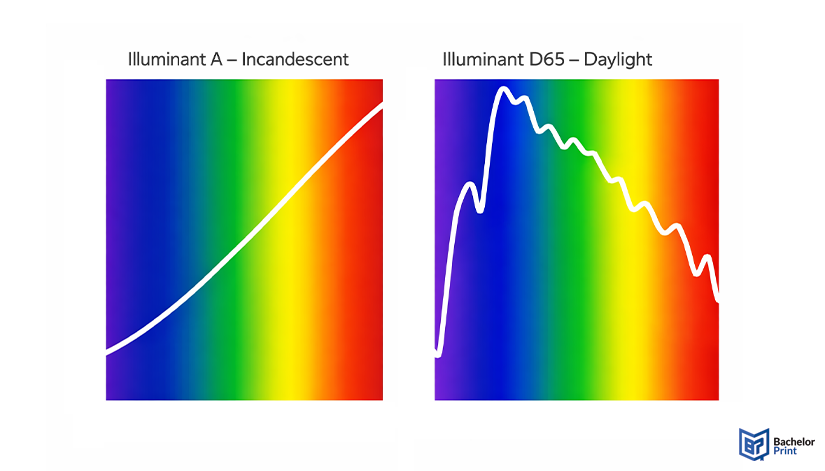
- Strongest energy in the red wavelength range
- Significantly weaker energy in the blue region
- Produces a warm, reddish appearance overall
Because of the high red output, objects under incandescent lighting tend to appear warmer or more reddish compared to daylight.
- Strongest energy in the blue region
- Relatively less emphasis in the red wavelengths
- Produces a cooler, more neutral daylight appearance
Under daylight conditions, blue components are emphasized more strongly than under incandescent light.
Why this causes metameric failure
- Under Illuminant A ➜ Both may stimulate the cone cells identically, because red wavelengths dominate the light source.
- Under D65 ➜ Differences in blue/green reflectance become more pronounced, since daylight contains stronger blue energy.
The visual match breaks down because the spectral interaction between the light source and material changes. That breakdown is called metameric failure!
Types
Metamerism is not limited to light source changes. There are several distinct forms.
The most common type.
- Two colors match under one light source.
- The match fails under another light source.
Typical in:
- Textile production
- Retail environments
- Print proofing vs. real-world lighting
Occurs when two people perceive a color match differently.
- One observer sees a perfect match.
- Another sees a mismatch.
Causes:
- Age-related yellowing of the lens
- Biological variation in cone sensitivity
- Subtle differences in visual processing
This is often seen in metallic paints, automotive finishes, and pearlescent coatings.
Here, the color match depends on:
- Viewing angle
- Surface texture
- Illumination angle
Real-world examples
Metamerism is not theoretical because it affects daily life and industrial production.
Why it matters in printing
Metamerism has direct implications for color accuracy, especially in professional environments.
Different lightning, different perception

In print workflows:
- Proofs are typically evaluated under standardized D50 lighting.
- Each lighting condition has a different spectral power distribution.
- Final products are viewed in retail spaces, offices, homes, or daylight.
A color match approved in a controlled print room may shift noticeable in real-world conditions.
The challenge of “impossible” matches

Printing often requires matching a physical reference sample using an entirely different set of colorants (typically CMYK inks).
Because:
- Their spectral reflectance curves differ.
- They are therefore almost always metameric pairs.
- The original and the printed version have different chemical compositions.
They may match perfectly under press lighting, yet appear different in a store or at home, which is not a production error but a limitation of color reproduction.
Substrates & ink behaviour

Metamerism is also influenced by material choice:
- Ink formulations influence spectral behaviour.
- Optical brighteners affect perceived whiteness.
- Coated and uncoated papers reflect light differently.
- Batch-to-batch substrate variation can introduce shifts.
Even small changes in paper or printing ink chemistry can increase metameric risk.
Branding & quality control

Color consistency is critical for brand perception.
- Visible mismatches can reduce trust.
- Consumers associate consistent color with quality and authenticity.
- Marketing materials must remain visually stable across environments.
Metamerism therefore becomes a quality control issue, not just a visual one.
The “neutral” problem

Metamerism is especially noticeable in neutral tones:
- Tans
- Grays
- Beiges
The human eye is highly sensitive to small shifts in these colors. A neutral gray can quickly appear greenish or pink under different lighting, making mismatches more obvious than in saturated color hues.
How professional printers minimize metamerism
While it cannot be eliminated entirely, it can be controlled. Professional strategies include:
- Light booths to evaluate prints under multiple illuminants
- Spectrophotometers to measure spectral data instead of visual matching
- ICC and DeviceLink profiles to improve color consistency between devices
Color management systems reduce variability and improve consistency, but they cannot override the fundamental physics that cause metamerism.
High-quality color copies from just CA$0.25
- Choose from different paper formats & paper weights
- Configure finishing options & add any extras you need
- Easy online ordering process with delivery to your doorstep
Learn more!
FAQs
Metamerism describes the phenomenon where two colors match under one lighting condition but appear different under another due to differing spectral reflectance properties.
No. Metamerism is a normal consequence of human trichromatic vision. Color blindness involves reduced or altered cone function, whereas metamerism occurs even with normal vision.
Metamerism cannot be completely eliminated, but it can be minimized. Evaluating colors under standardized lighting, using spectrophotometric measurements, and selecting pigments with similar spectral reflectance curves help reduce metameric mismatch.
