
Additive colors are created by adding light, not pigments. This principle explains how screens generate color and why digital files can look different once converted for print color on paper. By combining red, green, and blue light (RGB), displays produce millions of colors, including white when all three are added at full intensity.
Additive colors explained briefly
Additive colors are created by combining different wavelengths of light. The model starts with black (no light) and builds toward white as red, green, and blue light are added together. This principle forms the basis of the RGB system used in digital screens and modern display technologies.
Definition: Additive colors
Additive colors refer to a method of creating color by mixing different wavelengths of light. Instead of combining physical substances like ink or paint, this model works by adding light together to produce new colors.
The additive color principle forms the foundation of how we perceive color on electronic displays such as televisions, smartphones, tablets, and computer monitors. These devices emit red, green, and blue light in varying intensities to generate the full spectrum of visible colors.
PDF printing at BachelorPrint from CA$0.14
- Upload your files & order printed PDFs in minutes
- Secure online PDF printing service with reliable delivery
- High-quality prints from any PDF, including reports & more
Learn more!
How it works
The additive process begins with black, which represents the absence of light. Color is created by adding light in different intensities. As more wavelengths are combined, the result becomes brighter, moving toward white.
The three primary additive colors are:
- Red
- Green
- Blue
Together, they form the RGB model.
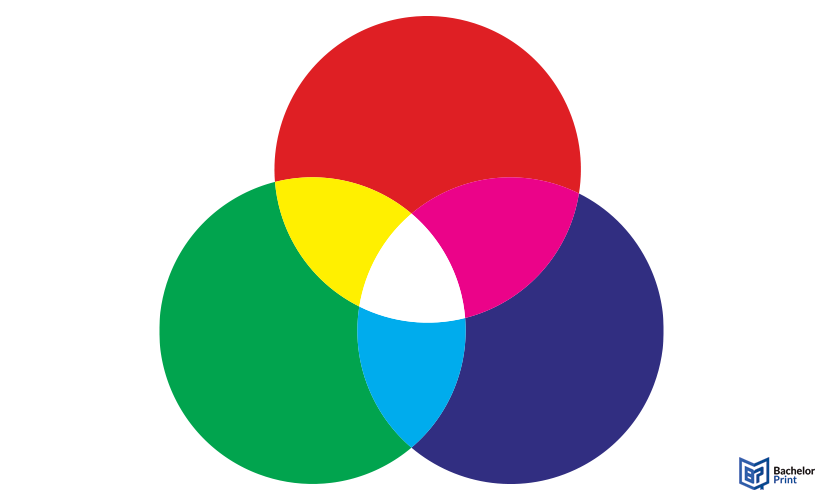
When two primary light color overlap at equal intensity, they create secondary colors:
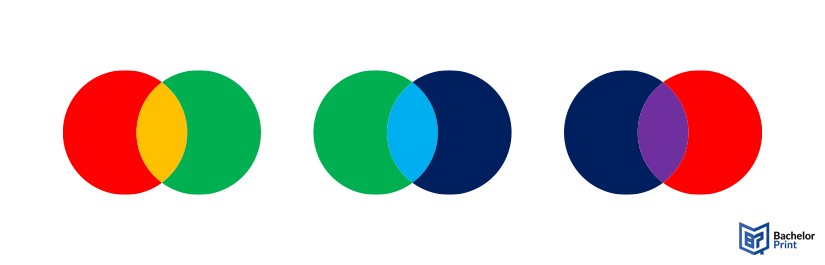
- Red + Green = Yellow
- Green + Blue = Cyan
- Blue + Red = Magenta
When red, green, and blue light are combined at full intensity, the result is white light.
Additive vs. subtractive colors
Additive color mixing is based on light, while subtractive color mixing relies on physical pigments such as paint or printing ink. The difference lies in how color is produced: emitted light versus reflected light.
Additive color (RGB)
Subtractive color (CMYK)
Medium
Light (emitted)
Pigments, printing ink, paint (reflected)
Starting point
Black (absence of light)
White (paper or surface)
Primary colors
Red, Green, Blue
Cyan, Magenta, Yellow
All combined
White light
Black or very dark tone
Common uses
In short, additive color builds brightness by adding light, while subtractive color reduces reflected light through layers of pigments or printing ink.
Why RGB?
The additive color system is based on how human vision works. Our eyes are trichromatic, meaning they contain three types of color receptors called cones. These cones are sensitive to red, green, and blue wavelengths of light.
Electronic displays mimic this biological mechanism. Each pixel on a screen consists of tiny red, green, and blue sub-pixels. By adjusting their intensity, the display stimulates our cones in different ways, allowing the brain to perceive millions of colors.
A deeper technical breakdown of the RGB color model is covered in the corresponding article.
Applications
Additive color mixing is used wherever color is produced through emitted light. Common applications include:
Devices that generate images directly through RGB light sources:
These systems rely on red, green, and blue sub-pixels to create the full visible spectrum.
Applications where coloured light is blended in real time:
In these contexts, additive color mixing controls atmosphere, mood, and visual impact.
Technologies that project or capture light-based color:
Here, color is either projected onto a surface or recorded using RGB-based sensor filters.
Printing services at BachelorPrint
- Individual solutions & personal support
- High print quality & fast production times
- Wide range of print products for every need
Learn more!
History

1666 – Isaac Newton
Demonstrated with a prism that white light is composed of multiple colors, laying the foundation for modern color theory.

1802 – Thomas Young
Proposed that human vision relies on three types of receptors sensitive to different wavelengths of light.

1861 – James Clerk Maxwell
Produced the first color photograph by combining red, green, and blue light projections, proving the additive principle experimentally.

1950s
Early color television systems adopted the RGB model, using red, green, and blue phosphors to reproduce images in homes.

Today
Modern smartphones, monitors, and laptops still rely on RGB sub-pixels, applying the same additive color principle discovered centuries ago.
FAQs
An additive color is created by combining different wavelengths of light. The more light that is added, the brighter the resulting color becomes.
No. Paint uses pigments and follows the subtractive color model, not the additive one.
RGB is called additive because colors are produced by adding red, green, and blue light together in different intensities.
The three primary additive colors are red, green, and blue.
