The accordion fold is a versatile paper folding method to divide a single sheet into multiple connected panels. It allows information and visuals to unfold step by step while remaining part of one continuous surface. Because it combines compact size with expandable layout space, it is widely used in both print communication and creative design.
Definition: Accordion fold
An accordion fold is a paper folding technique used in print production and graphic design to divide a single sheet into multiple connected panels. It is valued because large information areas can be condensed into a compact format while preserving visual continuity.
The sheet is folded back and forth in alternating directions, creating a sequence of parallel pleats formed by repeating mountain and valley folds. Unlike folds where panels nest inside each other (e.g., letter folds), accordion panels alternate outward, producing a zig-zag profile when viewed from the side.
- Fan fold
- Zig-zag fold
The structure resembles the expandable bellows of an accordion, which compress and extend while remaining connected in one continuous piece.

How to accordion fold
Accordion folding is based on a repeating reversal of fold direction. Precision is critical in print contexts, because uneven panels or skewed creases will misalign printed content.
Step-by-step process
- Reference fold
Start by folding the sheet in half. This establishes a center reference line that helps maintain symmetry and panel accuracy.
- First directional fold
Fold one outer edge toward the center line. Align edges precisely to avoid cumulative deviation.
- Reverse direction
Flip the sheet and fold the opposite edge toward the center. This creates the first directional change, forming the zig-zag structure.
- Continue alternating
Repeat the process, always folding in the opposite direction of the previous fold. When viewed from the side, the structure resembles a “W” or “M” profile.
- Sharpen creases
Use a folding bone or a straight, firm edge (e.g., a table edge) to create crisp, consistent fold lines. Sharp creases are essential for professional print pieces.
Note: For visual learners, video tutorials can help illustrate the mechanical logic of alternating folds.

Products
Accordion folds are primarily used for structured documents that contain sequential or segmented information. The format allows large amounts of content to remain connected while folding down to a compact size.
Reports
Long documents where sections benefit from physical segmentation to remain continuous.
Price lists
A clear way to organise services, products, or pricing tiers across panels without breaking the flow.
Affordable document printing from £0.08
- Crisp text, vibrant colors & multiple paper choices
- No need to visit a shop; simply order online anytime
- Print documents, copies & reports with professional quality
Learn more!
Common uses
The accordion fold appears across multiple fields where expandability, segmentation, and compact storage are functional advantages.
A folding structure that divides a sheet into multiple connected panels, allowing content to unfold progressively while staying on one continuous surface.
➜ Effective for communication that benefits from sequential information flow and large visual surfaces in a compact format.
The structure is widely used in art and design because it allows continuous visual storytelling.
➜ Ideal for panoramic visuals and display-oriented printed works.
Accordion geometry is also applied to expandable storage systems.
➜ Allows capacity to increase while maintaining separation between sections.
Panel layout
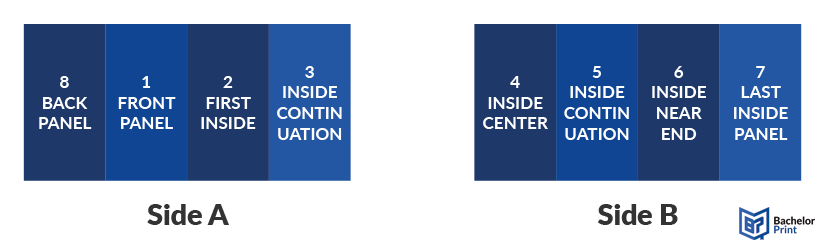
Understanding panel order in an accordion fold is essential because, unlike a C-fold, the number of panels is not fixed. The fold can extend to 4, 6, 8, 10, or more panels, but the reading logic always follows the same principle.
- Side A (outer side): Panels appear in a continuous strip when fully opened.
- Side B (reverse side): Panels follow a strip, but order depends on the starting edge and fold direction.
When folded with six panels
- Side A (outer side, read left ➜ right when fully opened): Panels 8 – 1 – 2 – 3
- Side B (reverse side, read left ➜ right when fully opened): Panels 4 – 5 – 6 – 7
Panel number
Position when folded
Typical purpose
1
Front panel
First visible panel; title, key visual, or headline
2
First inside
Opening information or introduction
3
Inside continuation
Main content or feature details
4
Inside center
Core message, visuals, or focal content
5
Inside continuation
Supporting information
6
Inside near end
Secondary details, highlights
7
Last inside panel
Summary or transition to closing
8
Back panel
Contact info, CTA, legal details
Pros & cons
Accordion folds offer structural and visual advantages but introduce production constraints that must be considered during print planning.
Pros
- No panel nesting
- Continuous visual flow
- High information density
- Compact distribution size
- Expendable display format
Cons
- Fold stress
- Lower durability
- Complex imposition
- Handling complexity
- Alignment sensitivity
Layout tips
Proper layout planning is critical because accordion folds introduce multiple fold lines and panel transitions that directly affect readability and alignment.
✅ Use a consistent grid
Uniform margins and column systems help maintain visual rhythm across panels.
✅ Allow for fold tolerances
Small production deviations can occur; avoid edge-critical alignment between panels.
✅ Keep safe zones near folds
Avoid placing text, logos, or fine details directly on fold lines to prevent distortion.
✅ Guide the reading direction
Use arrows, numbering, or visual flow elements to indicate how the piece unfolds.
✅ Design by panels, not pages
Treat each segment as an individual communication unit while maintaining overall continuity.
✅ Plan for full-extension viewing
Ensure the design also works when the entire sheet is opened as one panoramic surface.
Printing services at BachelorPrint
- Individual solutions & personal support
- High print quality & fast production times
- Wide range of print products for every need
Learn more!
Considerations
Accordion folds affect not only design but also material choice and production behaviour.
❌ Grain direction
Folding against the paper grain can cause fibre breakage and rough edges.
❌ Final folded size
Must be planned according to envelopes, packaging, or display requirements.
❌ Panel count escalation
More panels nasty more cumulative alignment tolerance issues.
❌ Finishing compatibility
Lamination, heavy paper coatings, or thick inks can weaken fold integrity.
❌ Paper GSM limits
Cardstock increases cracking risk at fold lines; very light papers lack structure.
❌ Double-sided complexity
Front/back layout must match the fold sequence to avoid upside-down panels.
FAQs
You fold the sheet back and forth in alternating directions, creating a sequence of parallel panels formed by repeated mountain and valley folds.
It’s also known as a fan fold or zig-zag fold.
Not exactly. A Z-fold is a specific type of accordion fold with a fixed three-panel structure that forms a “Z” shape. An accordion fold is the broader term and can include more panels, as the back-and-forth folding pattern can continue beyond three sections.
In a roll fold, panels wrap inside one another in the same direction, while in an accordion fold, each panel reverses direction, forming a zig-zag structure.
