
The ISSN is a globally recognized identifier for serial publications. Within professional printing terms, it serves as a key reference point for cataloguing, distribution, and library systems. It ensures that journals, magazines, and other ongoing publications can be distinguished even when titles are similar or change over time. The system supports both print and digital formats.
ISSN explained briefly
The ISSN is an eight-digit code that uniquely identifies serial publications worldwide. Its structured format includes a check digit for error control, and separate ISSNs exist for print and online versions. It is assigned via national ISSN centers and differs from ISBN (books) and DOI (individual articles).
Inhaltsverzeichnis
Definition: ISSN
The ISSN (International Standard Serial Number) is an internationally standardized eight-digit code used for serial publications, such as journals, magazines, newspapers, and newsletters.
- Administered by the ISSN International Centre in Paris
- Supported by a network of 90+ national centers worldwide
Two formats:
- p-ISSN ➜ identifies the print version
- e-ISSN ➜ identifies the electronic version
It ensures that serial titles can be clearly identified and distinguished in global publishing and library systems.
History
- 1971: The system was drafted by the International Organization for Standardization to address library cataloguing problems caused by identical or changing journal titles.
- 1975: The ISSN International Centre officially opened in Paris following an agreement between UNESCO and the French government.
- 1990s–2000s: Expansion from print-only publications to digital media led to the introduction of the e-ISSN for online journals.
- Today: A global network of nearly 90 countries now manages more than 2.5 million ISSN identifiers for serial publications worldwide.
Copy and print from CA$0.14
- High-quality copies & prints for any project
- Vibrant color prints or sharp black & white prints
- Online copy and print services delivered straight to your door
Learn more!
Relevance
The ISSN is operationally important across publishing, library science, and academic research.
- It distinguishes serial publications with identical or very similar names, even across countries or languages.
- It’s used by libraries and retailers for ordering, cataloguing, distribution, and inventory management.
- It enables researchers and citation systems to reference the correct serial title, reducing ambiguity.
Structure
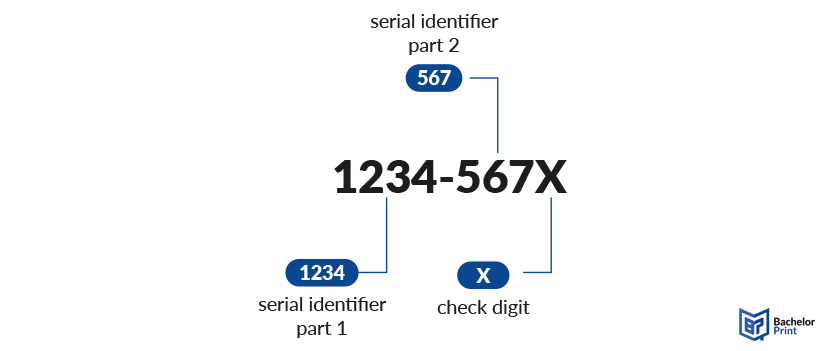
An ISSN follows a fixed numerical format designed for consistency and machine readability. It always contains eight characters, divided into two blocks.
- Two groups of four digits separated by a hyphen
- The eighth digit is a check digit
Note: If the calculation result equals 10, the Roman numeral “X” is used for the check digit to keep the code at exactly eight characters.
Part
Position
Function
First block (1234)
Digits 1–4
Identifies the serial title group
Second block (567)
Digits 5–7
Further distinguishes the title
Check digit (9 / X)
Digit 8
Validates the number mathematically
Why do you need a check digit?
The check digit is the eighth character of an ISSN and functions as a mathematical control mechanism. It’s designed to detect errors that occur when an ISSN is manually typed or stored in a database. In practical terms, it acts like a verification key that confirms whether the preceding seven digits form a valid identifier.
Rather than being random, this digit is calculated using a defined formula. If the number entered does not produce the correct result, systems can immediately recognize the ISSN as invalid.
Function
What it prevents
Practical example
Error detection
Typing mistakes and digit swaps
A researcher enters 1234-5769 instead of
1234-5679
Searching for non-existent serials
A database flags the ISSN before processing
the query
Fraud detection
Fake or invented identifiers
Predatory journals listing fabricated ISSNs
How does the check digit work?
The ISSN check digit is calculated using a Modulus 11 system. This mathematical method ensures that the number sequence is internally consistent and can be verified automatically.
Formula overview
- Each of the first seven digits is multiplied by a weight from 8 down to 2
- All resulting values are added together
- The total is divided by 11 to determine the remainder
- The remainder is subtracted from 11 to produce the check digit
If the result equals 10, the check digit becomes X. If the result equals 11, the check digit becomes 0.
ISSN vs. ISBN vs. DOI
These identification systems are often confused because they appear in similar publishing and academic contexts. However, each one operates at a different level of identification and serves a distinct purpose:
Identifier
Use
Example
Purpose
ISSN
Journals, magazines
ISSN 1234-5679
Identifies a periodical title, not single issues
ISBN
Printed books, ebooks
Identifies a specific book edition or format
DOI
Academic articles, online publications
10.1000/xyz123
Provides a permanent digital link to an individual article
How to get
An ISSN is assigned through the national center responsible for the country of publication. The process is standardized internationally but handled locally, meaning applicants work with the authority that covers their publisher’s location.
Step 1: Identify your ISSN center
Each country operates its own registration body within the global ISSN network:
- United States: ISSN Uplink portal at the Library of Congress
- United Kingdom: ISSN UK Centre at the British Library
- Canada: ISSN Canada at Library and Archives Canada
- Other Countries: Use the ISSN International Centre’s search tool to find your national center.
If no national center exists for your country, the application is submitted directly to the ISSN International Centre in Paris.
Step 2: Prepare required documentation
Authorities require proof that the serial publication exists and meets formal publishing standards. Typical documentation includes:
- Title (clearly displayed and used consistently)
- Publisher details (official name and contact address)
- Editorial information (editorial responsibility or board)
- Publication frequency (how often the serial appears or is updated)
- URL (for online publications, the website must be live and accessible)
Step 3: Submission process
While portals differ slightly by country, the workflow usually follows this structure:
- Register on the relevant portal
- Provide bibliographic details about the title, format, and launch date
- Pay fees if applicable (registration is free in the US, UK, Canada, and Australia)
- Wait for the reviews (from 10 working days to 6 weeks)
Important eligibility rules
Not every publication qualifies. Key restrictions include:
- Only serials are eligible (books and one-time publications require an ISBN instead)
- Each format needs its own ISSN (print and online versions are registered separately)
Dissertation or thesis printing and binding
- Fast production & express delivery to meet your deadline
- Professional thesis & dissertation printing & binding services
- Premium materials, hard & soft bindings for a lasting impression
Learn more!
How to find
Locating an ISSN is usually straightforward, whether you are working with a print issue or an online journal.
Note: When using a search engine, enter the journal title + ISSN to surface official publisher or database records.
- Print
- Upper right corner of the front cover
- Masthead or editorial page if not on cover
- Online
- Journal homepage
- “About this journal” section
- Barcode
- On magazines, the ISSN appears directly above the barcode
- ISSN Portal
- ISSN International Portal
- Indexed over 2.5 million titles worldwide
- You can search by title, country, or subject
- National catalogs
- Many countries have their own searchable registries
- Examples: U.S. Library of Congress or ISSN Canada
- Use Scopus & DOAJ if you’re looking for academic journals
- Google Scholar often displays the ISSN in the sidebar or citation details
- DOI lookup tools can help retrieve the journal record, including its ISSN
FAQs
ISSN stands for International Standard Serial Number. It is an eight-digit identifier used to uniquely distinguish serial publications such as journals, magazines, newspapers, and continuing newsletters.
No. An ISSN identifies the entire journal or serial title. A DOI identifies a specific article or digital object within that publication.
No. ISSNs are assigned to recurring publications. ISBNs are assigned to individual books or editions.
It’s typically printed on the cover or masthead of a physical issue, listed in the “About” section of an online journal, or searchable via the ISSN International Portal.
