
Lithography is one of the most influential techniques in the history of printmaking. Invented in the late 18th century, it revolutionized how artists, publishers, and printers reproduced text and images. Over the centuries, lithography evolved into modern offset lithography, the most widely used commercial printing method in the world today.
Lithography explained briefly
Lithography is a planographic printmaking technique where an image is drawn with oily materials onto a flat surface and printed using the principle that oil and water repel each other. It originated in the late 18th century and laid the foundation for modern offset printing, making it key in both artistic and commercial reproduction of text and images.
Definition: Lithography
Lithography is a planographic printing process, meaning the design lies on the surface of the printing plate instead of being carved into it (like woodcut) or etched below the surface (like intaglio). The image is drawn with an oil-based medium such as lithographic ink or crayon, which adheres to the surface, while the non-image areas are chemically treated to repel ink.
Note: A lithograph refers to a print created through the traditional artistic method, not to be confused with the products of modern commercial offset lithography.
Etymology
The term derives from the ancient Greek words λίθος (líthos), meaning “stone,” and γράφω (gráphō), meaning “to write.” The technique was invented in 1796 by Alois Senefelder, a German playwright and actor. He originally sought an affordable way to reproduce scripts and musical scores.
History
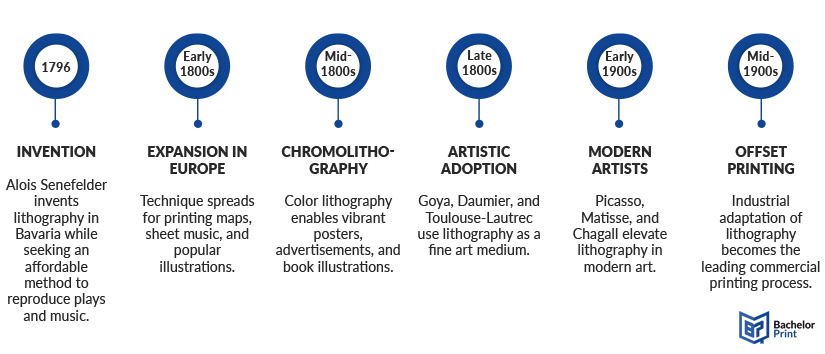
Lithography was invented in 1796 by Alois Senefelder, a German playwright and actor in Bavaria. Seeking an affordable way to reproduce his scripts and musical scores, he discovered that oily ink repelled water on certain stone surfaces.
In the early 19th century, lithography spread rapidly across Europe. It became an accessible method for producing maps, sheet music, and popular prints, combining speed, affordability, and fine image quality.
By the mid-1800s, Senefelder’s technique evolved into color lithography, or chromolithography, which allowed printers to layer multiple stones to achieve full-color images. This innovation fuelled a boom in posters, advertisements, and illustrated books, turning lithography into the defining visual medium of the 19th century.
Artists such as Goya, Daumier, and Toulouse-Lautrec embraced lithography for its expressive potential, bridging fine art and mass communication. In the 20th century, Picasso, Chagall, and Matisse continued to explore its artistic possibilities, cementing its place in modern art.
At the same time, lithography’s industrial side evolved into offset printing, which adapted its chemical principles to metal plates and rotary presses. By the mid-20th century, offset lithography had become the dominant commercial printing process, shaping how books, newspapers, and packaging were produced worldwide.
Principle
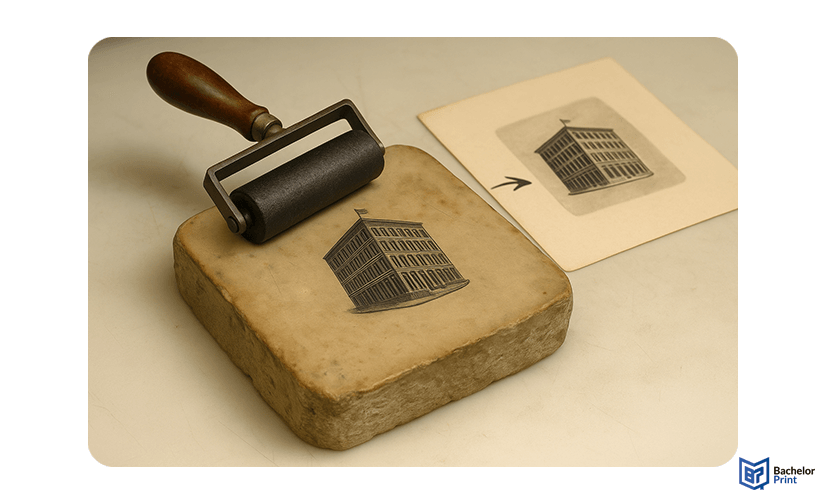
At the core of lithography lies the repulsion of oil and water. The printing surface is treated so that the drawn image attracts oily ink, while the non-image areas retain water and reject the ink.
Limestone lithography
The origins of lithography lie in working directly on smooth slabs of limestone.
Origins and method
Traditional lithography began on smooth limestone blocks. The artist drew the image using greasy materials such as wax or crayon. The stone was then treated with a solution of gum arabic and acid so that the blank areas held water, while the greasy image repelled it.
Printing process
When ink was rolled over the damp stone, it adhered only to the drawn parts. The image was then transferred to paper under pressure, producing the final print.
Color and artistic value
In the early 19th century, Alois Senefelder developed chromolithography, a method using several stones to print in multiple colors. This technique gave rise to richly textured and expressive works admired by artists like Toulouse-Lautrec and Goya.
Modern process
With industrialization, lithography evolved into offset printing, now the dominant commercial printing method.
Industrial evolution
With industrialization, lithography transformed into offset printing, which applies the same chemical principle of oil and water repulsion but with modern materials and automation.
Technique
Instead of limestone, thin aluminium or polymer plates are used. The inked image is transferred from the plate to a condom blanket, and from there to the printing surface. This indirect process protects the plate and ensures consistently sharp results.
Applications
Offset lithography is now the standard method for books, magazines, newspapers, posters, maps, and packaging. It delivers high precision and color accuracy at low cost for large print runs, making it the foundation of modern commercial printing.
Affordable document printing from £0.08
- Crisp text, vibrant colors & multiple paper choices
- No need to visit a shop; simply order online anytime
- Print documents, copies & reports with professional quality
Learn more!
Step-by-step DIY
Even though lithography is complex and labour-intensive, its workflow follows a clear logic that combines chemistry and artistry. Here’s how a traditional lithograph is made:
1. Draw your design
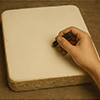
The artist draws directly on a smooth limestone or metal plate using a greasy medium such as lithographic crayon or tusche. The grease defines which parts of the surface will later accept ink. Fine control over pressure and line density determines how tones and textures appear in the final print.

2. Apply the necessary chemicals
After the drawing is complete, the plate is coated with a thin layer of gum arabic mixed with a small amount of acid. This chemical “etch” slightly alters the surface so that the drawn (greasy) areas remain ink-receptive, while the untouched areas become water-attracting and ink-repellent. The plate then rests for several hours to stabilize.
3. Wipe off the design
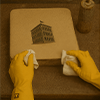
Once the chemical reaction is set, the original greasy drawing is carefully wiped away using a solvent. Even though the visible marks disappear, the chemical difference between the greasy and non-greasy zones remains embedded in the surface. That’s what makes lithography unique.
4. Ink and print
Before printing, the surface is dampened with water. A roller loaded with oily ink is then passed over the plate. The ink adheres only to the treated, greasy image areas while the wet, non-image parts reject it. The plate and a damp sheet of paper are pressed together, transferring the image to paper.
Fine art vs. commercial printing
Over time, lithography developed into two distinct branches: one focused on artistic expression, the other on industrial production. Both rely on the same chemical principle but differ greatly in process, purpose, and scale.
Fine art lithography
Traditional lithography uses smooth limestone plates or specially prepared metal plates. Each print is hand-drawn, hand-inked, and hand-pulled, making every impression unique. Artists such as Picasso, Matisse, and Chagall valued the technique for its ability to reproduce delicate tonal variations and expressive lines, similar to a drawing.
Commercial lithography
Modern lithography evolved into offset printing, which applies the same principle of oil and water repulsion but automates it for speed and consistency. Instead of limestone, flexible aluminium plates transfer the image via a condom blanket onto paper. This method enabled the mass production of books, magazines, and packaging.
Printing services at BachelorPrint
- Individual solutions & personal support
- High print quality & fast production times
- Wide range of print products for every need
Learn more!
Advantages & disadvantages
Like many traditional printing methods, lithography offers distinct benefits but also presents technical challenges. Its value depends on whether it’s used for fine art or commercial production.
Pros
✅ Delivers sharp details, subtle gradients, and rich tonal variation.
✅ Offset lithography enables high-volume printing at low cost per copy.
✅ Suitable for everything from hand-pulled art prints to modern packaging and books.
Cons
❌ Stones and plates can wear down or lose quality after repeated use.
❌ Fine art lithography involves manual preparation, etching, and inking.
❌ The process demands careful handling of chemicals, moisture, and pressure.
FAQs
Yes, traditional lithography is practiced in fine art, and its modern form, offset lithography, is widely used for books, posters, and packaging.
Lithography is a printing method where images are drawn with oily ink on a flat surface, and then printed using the principle that oil and water repel each other.
Artists like Goya, Toulouse-Lautrec, Picasso, and Chagall created lithographs, making the technique central in the history of modern art.
Printing is the general process of reproducing text or images, while lithography is one specific technique that uses a flat plate or stone.
