
Perforated paper is an essential material used in a wide range of applications, from office settings to packaging, textiles, and ticket industries. As one of the various printer paper types, it allows for easy separation of sheets without causing damage, saving its buyers a lot of time. This article delves into the key aspects of perforated paper, its uses, types, and possible alternatives to perforated paper.
Inhaltsverzeichnis
Definition: Perforated paper
Perforated paper refers to a sheet of paper that has a line of small holes punched into it, typically with a perf or perforating machine, blade, or roller. These perforations (or perfs) are strategically placed to make it easier to separate portions of the paper, whether for business forms, tickets, or coupons.
The holes are punched in a regular pattern, which allows for clean tearing without the risk of damaging the surrounding paper if done correctly. Pre-perforated paper is typically compatible with both laser printers and inkjet printers.
Certificate printing at BachelorPrint
- Choose from fine papers with premium finishes
- Custom certificate printing for any occasion from £0.08
- Celebrate achievements & awards with elegant certificates
Learn more!
Uses
Some of the many uses of perforated paper are listed below.
- Labels
- Coupons
- Notebooks
- Event tickets
- Inventory tags
- Gift certificates
- Notices
- Invoices
- Bookmarks
- Raffle tickets
- Cheque books
- Postage stamps
Tear resistance
In this section, we will get a bit technical. TPI (teeth/ties per inch) is a way to measure how fine or coarse a perforation is. It tells you how many tiny cuts or holes (called “teeth”) are made per inch along the perforated line. Tie width is another perforation specification, which refers to the space between the teeth. For regular printer paper, a so-called (micro) perforating rule can be used to create a straight line of perforations, as seen in the image below.
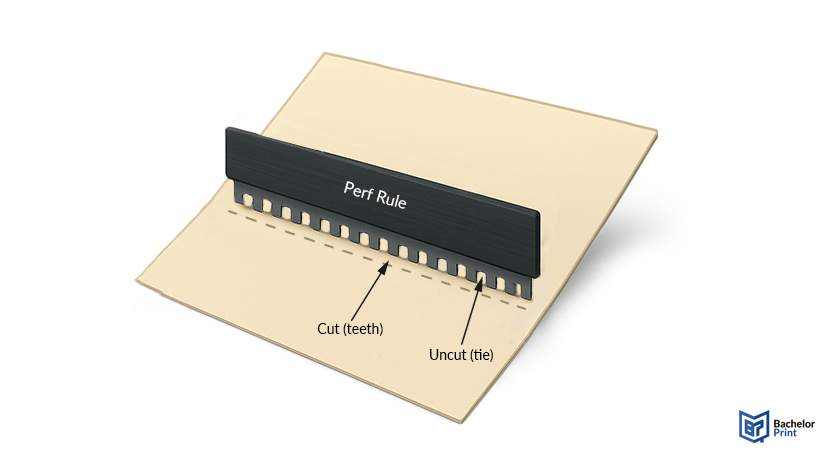
While paper, especially cardboard, is measured through burst strength (pressure needed to tear it apart), perforations are measured by tear strength (physical effort necessary for removal of the perf). Perforating essentially weakens the paper by making partial cuts, which in turn affects the paper’s burst strength. Based on the TPI value, perforated paper can exhibit varying degrees of tear resistance (percent of hold), which can be calculated with the following formula:
TPI × Tie width = Percent of hold
Below, you can find an example.
Types
There are two primary types of perforations used in various applications: macro and micro perforations with either square-shaped or V-shaped teeth. Each one will be explained below.
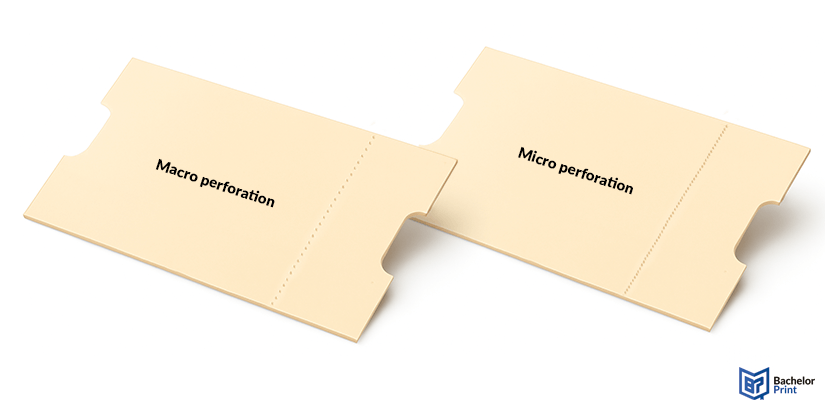
Macro perforation (or standard perforation) can range from 3 TPI to 18 TPI and uses fewer, larger teeth with wider tie widths. Macro perf tears harder with a higher TPI.
| TPI range | Tear strength | Common uses |
|---|---|---|
| 3–6 TPI | Light release | Packaging tear strips, forms, tickets, coupons, paper towels |
| 7–10 TPI | Medium release | Invoices, direct post, bills, notebook paper |
| 11–18 TPI | Stiff release | Durable direct post, stamps, forms, documents, tickets |
Note: 11-18 TPI perforations normally need to be folded before tearing them off.
Micro perforation (or microperf) uses a higher number (20-300 TPI) of finer cuts with very small tie widths. This results in cleaner, almost invisible edges when torn. Micro perf tears more easily with a higher TPI.
| TPI range | Tear strength | Common uses |
|---|---|---|
| 20–30 TPI | Clear tear; moderate release | Coupons, postcards, tickets, tear-off stickers |
| 31–50 TPI | Smoother tear; stiff release | Notebooks, documents, promotional inserts |
| 51–100+ TPI | Very smooth; minimal edge damage | Tickets, mailers, fine-printed items |
Alternatives
While you can go down the easy route by purchasing perforated paper, there are other methods and tools you can use to achieve similar results at home.
Needles
You can use a sewing needle or pin to manually punch holes along a drawn perforation line on your paper. This, of course, can be labour-intensive, but it requires special tools. This alternative works well for light perforations or one-off projects.
Perforating tool
A handheld device, like a perforating blade with evenly spaced metal teeth, can be rolled across paper to create a line of perforations similar to a pizza cutter wheel. Make sure to place a cutting mat underneath your paper before starting your project.
Your guide to print and production
- Information on print finishing & print processing
- Information on materials & optimal use of materials
- Information on printing processes & print production
Learn more!
FAQs
Yes, you can! Perforating paper at home is possible using a perforating tool or a sewing needle. For higher volume, a perforating machine or pre-perforated paper is recommended.
To make perforated paper, you create a line of tiny cuts in the paper using a sewing needle or a rolling perforating tool. Mark your line first for accuracy, and always test on scrap paper before working on final materials.
If you don’t want to use or don’t have perforated paper at hand, there are several alternatives for creating tearable sections:
- Sewing needles
- Perforating tools
Perforated paper is a sheet of paper that has a row of small holes or cuts, which allow part of the sheet to be torn off easily and cleanly. It’s commonly used for forms, tickets, coupons, and packaging.
