
A pigment is the key ingredient behind every vibrant print color, giving inks and paints their lasting tone, depth, and intensity. Unlike dyes, pigments are insoluble, which makes them durable, resistant to fading, and suitable for long-term applications. They have been used for thousands of years. Without pigments, the world of art, design, and printing would lack the brilliance and stability we take for granted.
Pigment explained briefly
A pigment is a colored, usually insoluble substance that provides color when mixed into inks or coatings. In printing, pigments are valued for their durability, lightfastness, and color stability compared to dyes.
Definition: Pigment
A pigment is a coloured substance, usually insoluble, that provides color when it is mixed into a medium such as paint, ink, or plastic.
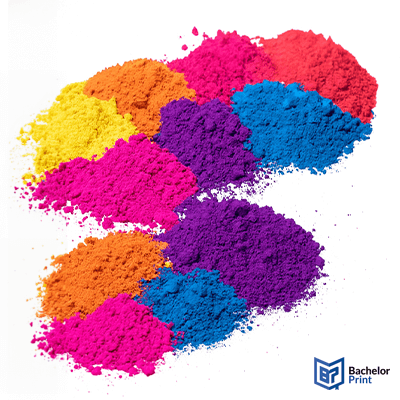
Pigments vs. dyes
Pigments
Dyes
Solubility
Insoluble (sit on surface)
Soluble (bond with material)
Durability
High, resistant to light & heat
Lower, can fade or bleed
Brightness
Strong, opaque colors
Often brighter but less stable
There’s also pigmented ink, which is ink made with pigments suspended in water. It delivers durable, fade-resistant colors, making it ideal for professional printing. This is different from dye ink, which dissolves into the medium and often produces brighter but less stable colors. We explain this in more detail in our article about pigmented ink, including a section on pigmented ink vs. dye ink.
Common uses
- Plastics and textiles
- Fine art (paints, pastels)
- Ceramics and industrial coatings
- Printing inks (books, packaging, posters)
- Cosmetics (lipsticks, eyeshadow, nail polish)
Paperback with your individual design
- Individual design for thesis, dissertation, or books
- Order online with fast delivery right to your doorstep
- Use a customizable pre-made design or create your own
Learn more!
Types
Pigments can be classified in several ways. The most common distinctions are based on chemical composition, origin, and special properties.
Organic vs. inorganic
- Made from carbon-based compounds
- Known for their bright and intense colors
- Often used in printing inks, plastics, and coating
- Derived from minerals, metals, or oxides
- Typically offer more opacity and stability
- Greater durability in harsh environments
Natural vs. synthetic
- Extracted from minerals, plants, or even insects
- Used since ancient times so historically significant
- But often less stable and can fade or react to light and chemicals
- Chemically engineered for consistency, a broader palette, and durability
- Most pigments used in today’s printing and industrial applications are synthetic because they are more reliable and cost-effective
Special effect pigments
- Adds shimmer and a pearlescent look
- Popular in decorative printing, cosmetics, and specialty coatings
- Made with aluminium, copper, or other metals
- Create reflective finished for packaging, automotive paints, and graphic design
- Absorb UV light and re-emit it as visible light
- Used for safety signs, high-visibility clothing, print designs, and fluorescent ink formulations
Popular pigments & their colors
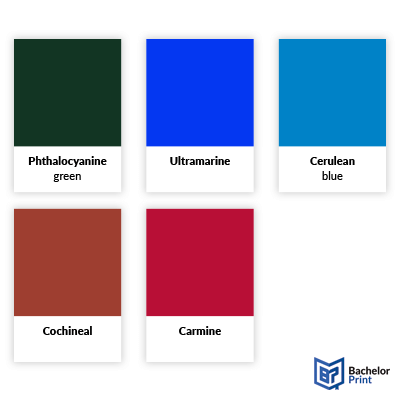
Some pigments have become especially well-known because of their distinctive color hues, stability, or unique origins. Here are a few of the most recognized:
Pigment
Origin
Typical use
Color tone
Phthalocyanine green
Synthetic
Printing inks, coatings
Dark blue-green
Ultramarine
Natural → Synthetic
Paints, printing, plastics
Deep blue
Cerulean blue
Synthetic
Fine art, printing, design
Sky blue
Cochineal red
Natural (insect)
Textiles, manuscripts
Intense red
Carmine
Natural (insect)
Art, food, cosmetics
Vivid red
Pigments in printing
Pigments are essential for creating reliable and durable print colors. They influence how vivid and long-lasting a print appears, making them central to both everyday products and high-quality art prints.
Why do pigments matter in printing?
- They provide color stability across different materials.
- They ensure strong opacity, preventing show-through on paper.
- They offer resistance to fading, even under light and heat exposure.
What are common applications?
Used for food wrappers, cosmetic boxes, and consumer product labels where vibrant, durable colors attract buyers and resist damage during transport.
Pigments allow for bright, washable designs on fabrics without bleeding, important for fashion and branded clothing.
Chosen for archival quality, ensuring posters, books, and reproductions keep their original look for decades.
Used in manufacturing, electronics, safety markings, and technical components where high resistance and readability are essential.
Environmental & safety considerations
- Stricter regulations on heavy metals and harmful compounds
- Growing demand for eco-friendly pigments, such as plant-based alternatives
- Development of sustainable printing inks to reduce environmental impact
History
The story of pigments is as old as human creativity. From cave paintings to Renaissance masterpieces, pigments shaped how people recorded their world and expressed ideas.
Early humans used ochre, charcoal, and chalk to decorate cave walls, leaving behind red, black, and white images that can still be admired today, for example in the Lascaux caves in France.
Ancient Egyptians expanded the palette further, creating vibrant blues from minerals such as azurite for use in murals and tomb decorations. Fun fact: The Egyptians also invented Egyptian Blue, the world’s first synthetic pigment, more than 4,000 years ago.
In medieval Europe, pigments became symbols of wealth and spirituality. The most prized was ultramarine, made by grinding lapis lazuli imported from Afghanistan. Its cost was higher than gold, so artists reserved it for sacred subjects like the Virgin Mary’s robes in paintings by Fra Angelico.
Around the 16th century, explorers brought cochineal red from the Americas to Europe. Derived from crushed insects, this vivid scarlet transformed the textile trade, became a symbol of luxury, and soon appeared in illustrated manuscripts, paintings, and even royal garments.
Renaissance painters such as Titian, Raphael, and Vermeer mastered the use of pigments like vermilion, lead-tin yellow, and ultramarine to create glowing, lifelike works. These colors gave their art incredible depth, though many natural pigments proved unstable and darkened over time.
The 18th and 19th centuries marked a turning point with the discovery of synthetic pigments. One of the first was Prussian blue (1704), which became iconic in European painting and in Japanese prints such as Hokusai’s The Great Wave. From that point onward, synthetic pigments steadily replaced natural ones, offering a broader, more stable, and more affordable color palette.
Production
Understanding how pigments are made helps explain why some were so rare in the past and why modern printing can now rely on an almost limitless color palette.
How was it made back then?
In antiquity and throughout the Middle Ages, pigments were obtained almost entirely from natural sources. Artists and craftsmen:
- Ground minerals such as ochre, malachite, or lapis lazuli into fine powders.
- Extracted plant dyes, like indigo, were processed and fixed to make pigments.
- Harvested insects, most famously cochineal, to produce the brilliant red known as carmine
This process was often expensive and time-consuming, and quality varied depending on the source. Fun fact: Ultramarine was so valuable that contracts sometimes required artists to use it only for the most sacred details, like the Virgin Mary’s robe.
How is it made today?
Modern pigment production is rooted in chemistry and industrial engineering. Instead of relying on rare natural materials, pigments are now:
- Chemically synthesized to achieve specific hues and properties.
- Optimized for different applications, whether for printing inks, plastics, textiles, or coatings.
- Processed through methods like precipitation, calcination, and surface treatment to control stability, brightness, and resistance.
Advances in production also address environmental concerns, with increasing demand for pigments that are eco-friendly, non-toxic, and low in VOC emissions.
The role of color systems
To make sure colors can be reproduced reliably, pigment production often relies on standardized color models. One important system is the Munsell color system, which organizes colors by hue (shade), value (lightness), and chroma (intensity). This allows manufacturers and printers to describe and match pigments precisely, ensuring that the same color looks identical across different media.
Online A4 printing for £0.08
- Quick production times & reputable delivery
- Professional A4 prints for personal and business use
- Configure the printing specifications for your A4-size prints
Learn more!
FAQs
A pigment is a coloured substance, usually insoluble, that gives color when mixed into a medium such as paint, ink, or plastic. Unlike dyes, pigments sit on the surface and provide long-lasting, stable color.
The oldest-known pigment is red ochre, an iron-oxide mineral used in cave paintings over 40,000 years ago. It’s still used today in art and coatings.
The term pigmentary refers to anything related to pigments.
Example
Pigmentary deposits in biology or pigmentary layers in paints and coatings.
In everyday language, people sometimes use words like colorant, colouring agent, or even dye as synonyms for pigment. However, in a technical sense, pigments and dyes are not the same: pigments are insoluble and sit on the surface, while dyes are soluble and chemically bond with the material.
The main difference is solubility. Pigments are insoluble and remain on the surface, giving strong opacity and durability. Dyes are soluble, bonding with the material itself, often producing brighter but less stable colors.
