In the realm of printmaking, there are countless techniques to transfer an image onto paper. There are dozens of types of printing ink or toner, as well as crafting techniques like linocut. One that especially stands out is thermal printing, as it requires no ink or toner cartridges at all, merely specially coated paper and the corresponding printer. The following article will explain the intricacies of thermal printing.
Definition: Thermal printing
Thermal printing is a planographic printing process that uses heat to make an image visible on special paper. The paper is coated with a heat-sensitive varnish, which changes color when it comes into contact with high temperatures. As there is no ink involved, thermal printing is a fast and handy solution for many print jobs that do not require colored, long-lasting prints.
Copy and print from CAN$0.14
- High-quality copies & prints for any project
- Vibrant color prints or sharp black & white prints
- Online copy and print services delivered straight to your door
Learn more!
Process
The process of thermal printing is rather simple, yet it requires special printer paper and a type of printer to work properly. The details of this process are explained below.
Materials
For thermal printing, the only materials needed are thermal paper and a suitable thermal printer.
- Thermal paper: Thermal paper is made through paper coating, where the sheet is first smoothed by a precoat layer before the thermal coat, containing leuco dye, is applied. Usually, the paper is made to change its color to black when heated.
- Thermal printer: A thermal printer contains a print head with tiny, electrically heated elements, which can switch temperatures very fast. This way, they create small dots, which are cooled down instantly again. For more detailed information about thermal printers, read the following article:
Printing
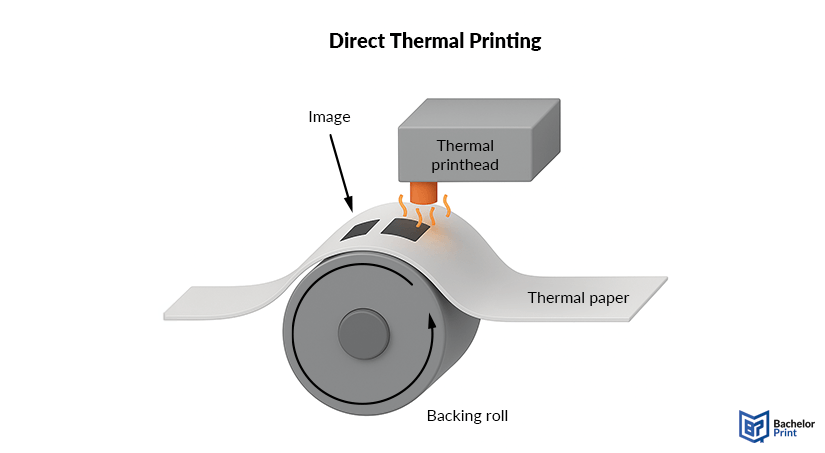
For the printing process, the special thermal paper is inserted into the printer. Usually, this type of printer paper is rolled up to save storage space. The paper is then transferred to the print head over a backing roll while the heated printhead connects with the paper in the locations that have to be blackened/colored. Although the printhead can heat to 150-185 °C (302-365 °F), since the heat is very punctual, the final print is just a little warm to the touch. As there is no ink involved, there is also no risk of smudging the product after the printing.
Use
Thermal printing can be used for various products. However, it should always be noted that thermal prints are sensitive to heat and sunlight, so there is no longevity to the final print. Therefore, they are ideal for short-term-use products such as:
- Invoices
- Receipts
- Labels for shipping
- Inventory management
- Price tags on retail shelves
Thermal transfer printing
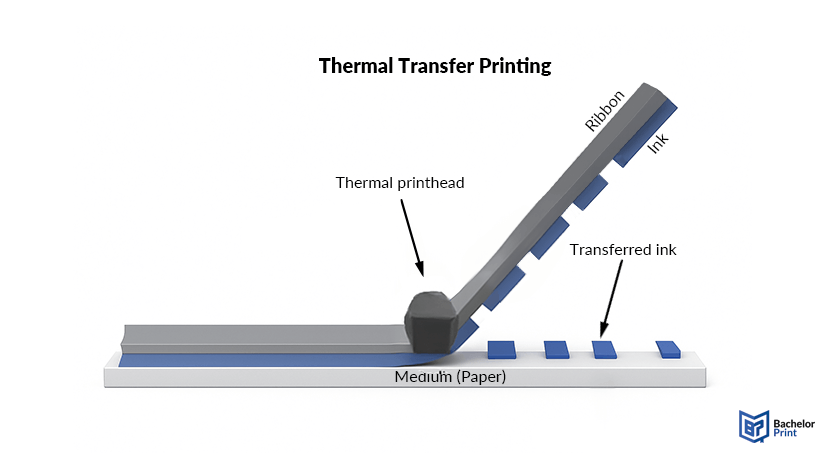
Thermal transfer printing needs to be separated from thermal printing, as it follows a different process. While thermal printing works through the reaction of heat-sensitive paper to a heated print head, without the use of ink, thermal transfer printing uses a special kind of ribbon ink. The ribbon consists of a backing and the hot-melt printing ink.
The print head in this process is non-movable and contains a set number of heatable dots, which result in the image resolution. The ribbon is inserted between the print head and the medium, which can be paper, fabrics, or other materials, before the heat melts the ink on the ribbon at the given spots, creating an image. Thermal transfer printing is especially useful on heat-sensitive surfaces or when a higher durability is required for the print job.
Advantages and disadvantages
Thermal printing sounds very useful at first, but there are also disadvantages to this printmaking process, as shown below.
Advantages
- Crisp prints and labels
- Ideal for short-term use
- Low cost due to few materials
- Less waste and smudging without ink
- Printers are easy to operate and often small or portable
Disadvantages
- Requires special paper
- Not suitable for big projects or longevity
- Only black & white, or monochrome prints
- Chemicals on the paper are not sustainable
- Extremely sensitive to external factors like heat or light
Print black & white copies online for CAN$0.14
- Print black & white copies in bulk or in small quantities
- Affordable single- & double-sided black and white copies
- Professional printing service for individual printouts
Learn more!
FAQs
Thermal printing is a type of printmaking, which does not use any ink. Instead, it works by darkening specially coated paper through heat.
No, thermal printers do not require any printing ink, as the process works by darkening a special paper coating through heat.
Thermal printing is mostly used for shipping labels, receipts, and other short-term usages.
