
Have you ever looked through two fences and seen strange waves that seemed to shimmer or move as you walked by? That optical effect is called a moiré pattern, and it’s a printing term that shows up more often than you realize. You’ll see it in everyday life, and in printing, where patterns interact and create unexpected visual distortions. This guide breaks down why moiré happens and how it influences printed images.
Moiré pattern explained briefly
A moiré pattern is a visual distortion of wavy, rippled lines that occurs when overlapping patterns interfere in printed images. It can reduce image quality, and printers adjust to prevent it.
Inhaltsverzeichnis
Definition: Moiré pattern
A moiré pattern is a large-scale interference pattern that appears when two similar repetitive structures, such as lines, grids, or dot patterns, overlap with slight differences in alignment, angle, or spacing. Instead of matching perfectly, the patterns are shifted, rotated, or have a slightly different pitch, causing visible waves, ripples, or curved bands.
Note: It is pronounced /mwɑːˈreɪ/ (“mwa-ray”).
Moiré patterns occur across mathematics, physics, art, and digital imaging.
- In printing, they appear when halftone dot screens interfere with each other or with fine image textures.
- In physics, the moiré effect is a form of wave interference, similar to the patterns observed in the double-slit experiment or the acoustic “beat” phenomenon.
- In television and digital photography, moiré can occur when a patterned object interacts with the pixel grid of a camera sensor, producing unwanted artifacts.
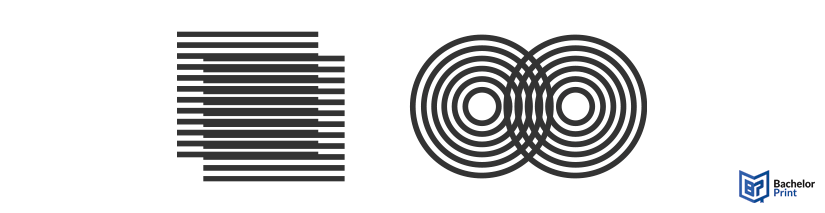
Formation
Moiré patterns form when two repetitive structures overlap in a way that creates visual interference.
- Where the lines or dots align, light areas show through, creating a light band. Where they misalign, they create a dark area.
- The misalignment between the high-frequency source patterns is visually magnified into a low-frequency pattern that is easily visible.
- Even slight motion of one pattern relative to the other causes the pattern to shift, often creating the impression of movement.
Print black & white copies online for CAN$0.14
- Print black & white copies in bulk or in small quantities
- Affordable single- & double-sided black and white copies
- Professional printing service for individual printouts
Learn more!
Types
Moiré patterns can appear in several forms, depending on how the overlapping structures interact. Although they often look delicate or faint, especially from a distance, they autumn broadly into two main categories:
These patterns occur unintentionally when two real-world structures overlap, such as fabrics, meshes, or repetitive textures. The effect is produced purely by optical interference.
These patterns are deliberately created or enhanced, for example, in textiles, decorative materials, or engineered applications where the moiré effect is pressed, printed, or designed into the material.
How to make
You can create moiré patterns easily using everyday objects or digital tools.
Physical methods
- Combs: Hold two identical combs a short distance apart and look through the teeth. Slide or slightly rotate one comb; the moiré pattern will shift and change shape.
- Fences: Look through a chain-link or picket fence at another behind it. As you move your head side to side, large wavy bands will appear to drift across the view.
- Create two copies of a fine repetitive pattern on clear acetate or transparency sheets.
- Layer the two sheets and shift the top one slightly.
- Tilting one pattern at a small angle creates circular or wavy moiré shapes.
- Moving one sheet horizontally or diagonally produces moving bands across the pattern.
- Overlap two pieces of window screen and slide or rotate one to reveal the moiré effect.
- Shine a light through one screen onto white paper behind it.
- Tilting the paper changes the shadow pattern and produces a moiré effect.
Digital methods
Use an online moiré pattern generator (e.g., on Wolfram|Alpha or the Molecular Expressions interactive tutorial) to adjust the pattern type, spacing, and rotation in real-time.
In Illustrator, GIMP, Affinity, or similar programs, create two layers of fine grids or halftone patterns. Slight rotation, distortion, or offsetting of one layer will immediately generate a moiré effect.
Function
Moiré patterns magnify extremely small differences between two repetitive structures. When two patterns align perfectly, no moiré appears. However, even the slightest variation in angle, spacing, or position produces a large, easily visible interference pattern.
Because of this amplification effect, moiré patterns are used in fields where detecting tiny movements, shifts, or deformations is essential. Engineers, physicists, and materials scientists apply moiré techniques to measure micro-displacements, analyse stress, and visualize structural changes that would otherwise be impossible to observe with the naked eye.
Common examples
Moiré patterns show up in many real-world situations whenever two fine, repetitive structures interact. They can be accidental visual distortions or intentional effects used in imaging and engineering.
Overlapping fences & meshes

When two grid-like structures overlap, movements create shifting wave patterns.
Textiles & fabrics

Fine weaves, meshes, and layered fabrics naturally produce moiré effects because of their repetitive thread patterns.
Digital imaging & cameras

Digital sensors have a fixed pixel grid. When this grid interacts with a patterned subject, moiré artifacts appear.
Printing & halftone screens

Printed images use CMYK halftone dots. Misaligned angles or scanning printed materials can create moiré.
Science & engineering

The moiré effect is intentionally used in technical fields to amplify tiny movements or structural changes.
Printing services at BachelorPrint
- Individual solutions & personal support
- High print quality & fast production times
- Wide range of print products for every need
Learn more!
FAQs
Looking through one chain-link fence at another behind it creates shifting wavy bands.
Slight differences in angle, spacing, or alignment between two repetitive patterns.
Large wavy, rippling, or circular bands that appear over fine patterns or textures.
It is pronounced “mwa-ray.”
